- Home
- Blog
- Hearing Protection
- Selecting Hearing Protection for 90, 100, and 110 dB(A): What Changes as Noise Increases?
Selecting Hearing Protection for 90, 100, and 110 dB(A): What Changes as Noise Increases?
Not all high-noise environments are the same. A facility operating at 90 dB(A) has very different risks and communication challenges than one operating at 110 dB(A). Yet many hearing conservation programs still rely on a single type of earplug or earmuff across all noise levels.
As noise increases, the risk profile, communication demands, and required protection strategy change dramatically.
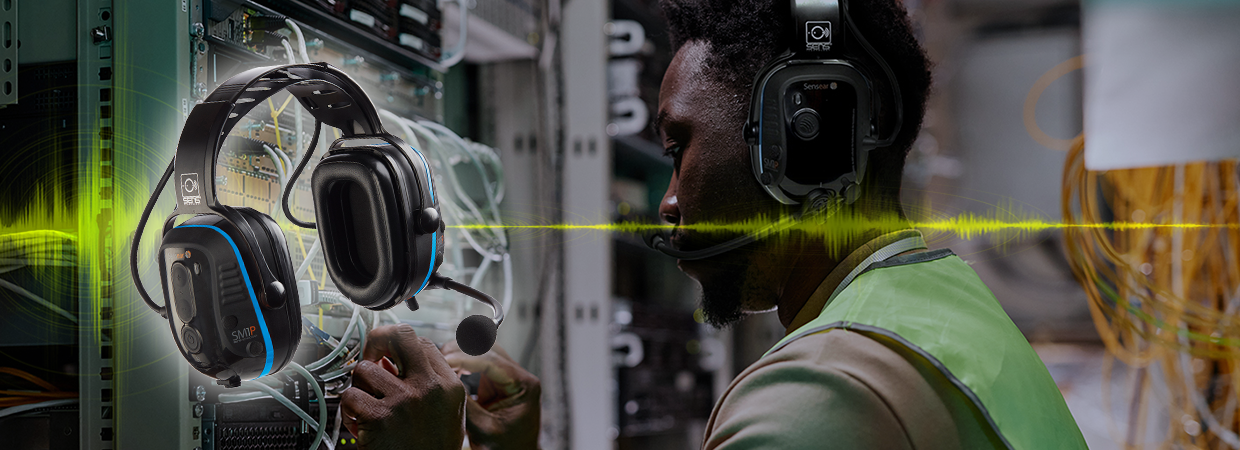
This guide breaks down what typically happens at 90 dB(A), 100 dB(A), and 110 dB(A) and how to match the right level of protection and communication capability to each environment. It also shows where modern high-noise communication solutions from Sensear fit into the equation.
Understanding the 85 dB(A) Baseline
The National Institute for Occupational Safety and Health (NIOSH) recommends limiting occupational exposure to 85 dB(A) as an 8-hour time-weighted average. At or above this level, hearing conservation measures are required.
As noise rises above 90 dB(A) and approaches or exceeds 100 dB(A), allowable exposure time drops rapidly and the margin for error shrinks. Selecting hearing protection based only on comfort or habit is no longer sufficient.
Around 90 dB(A): Protection is Necessary and Communication Starts to Suffer
What 90 dB(A) Looks Like
Noise levels around 90 dB(A) are common in:
- Manufacturing floors
- Warehousing and logistics hubs
- Light aviation ground operations
- Some construction environments
- Lower-density data center environments
At this level, hearing protection is required for sustained exposure. However, communication challenges are just beginning to emerge.
Common Problems at 90 dB(A)
- Workers raise their voices to communicate
- Radio volume is increased to overcome background noise
- Standard earplugs reduce speech clarity
- Situational awareness begins to degrade
Many sites issue basic disposable foam earplugs or passive earmuffs. While these may provide sufficient attenuation, they often degrade speech clarity and communication efficiency.
What Works at 90 dB(A)
At this level, solutions should:
- Provide appropriate NRR protection
- Enhance speech clarity rather than simply block sound
- Allow workers to hear alarms and environmental cues
This is often where integrated communication headsets become valuable. Instead of forcing workers to remove protection to communicate, Sensear's in-ear and headset solutions use SENS® Technology to suppress harmful noise while enhancing speech and preserving environmental awareness.
For environments consistently around 90 dB(A) with active communication needs, moving from passive PPE to intelligent sound management can significantly improve both safety and productivity.
Around 100 dB(A): Dual Protection and Communication Become Critical
What 100 dB(A) Looks Like
Sustained 100 dB(A) exposure may occur in:
- Heavy manufacturing
- Metal fabrication and forging
- Mining operations
- Aircraft engine proximity
- High-density data centers, especially newer AI and GPU-focused facilities
Modern AI-driven data centers are pushing power density and cooling systems to new limits. Increased airflow, high-performance fans, and dense equipment layouts have raised sustained noise levels in certain zones. In some facilities, technicians are now working in areas that exceed 100 dB(A) during peak cooling demand or specific maintenance tasks. At this level, the risk of hearing damage accelerates and communication becomes more difficult.
The Shift in Data Center Noise Profiles
Historically, many data centers operated in the 80 to 90 dB(A) range. However, the rapid growth of AI workloads has changed that equation.
High-density GPU racks and advanced cooling systems have increased:
- Continuous fan noise
- Airflow velocity
- Mechanical vibration
- Sustained background decibel levels
This creates a unique challenge. Data center technicians must:
- Communicate clearly
- Maintain awareness of alarms and system alerts
- Work in confined aisles and tight mechanical spaces
- Often integrate with helmets, safety eyewear, or respiratory protection
In these environments, traditional earplugs may provide attenuation but degrade speech clarity and communication efficiency. As noise levels approach or exceed 100 dB(A), integrated high-noise communication systems become increasingly important.
Sensear's solutions are particularly well suited for these environments because they combine attenuation, speech clarity, and compatibility with other protective equipment such as PAPR hoods or respirators.
Common Problems at 100 dB(A)
- Plug and muff combinations block too much sound
- Workers struggle to hear radio traffic
- Situational awareness drops significantly
- Dual protection is worn inconsistently
Traditional dual protection can create isolation. Workers may technically be protected but practically disconnected from their surroundings.
This leads to a dangerous cycle:
1. Protection blocks communication
2. Workers remove or loosen PPE
3. Risk increases
What Works at 100 dB(A)
At this level, protection must be paired with controlled communication.
Sensear offers:
- Dual protection headsets that provide high attenuation while maintaining complete awareness
- Integrated two-way radio connectivity
- Bluetooth® capability for modern communication workflows
- Helmet-mounted and intrinsically safe options
With up to 36 dB NRR of attenuation (38 dB SNR) available in certain dual protection models, these systems allow safety teams to protect hearing without sacrificing coordination and awareness.
110 dB(A) and Beyond: Passive Protection Alone is Not Enough
What 110 dB(A) Looks Like
Noise levels at or above 110 dB(A) are considered extreme and may occur in:
- Blasting and heavy mining
- Jet engine testing and maintenance
- Certain petrochemical operations
- Large-scale heavy equipment environments
Exposure limits at this level are extremely short. Even brief unprotected exposure can cause damage. In some high-density industrial or AI-driven environments, localized hotspots may approach these extreme levels during peak cooling demand or specialized maintenance activities.
Common Problems at 110 dB(A)
- Communication becomes nearly impossible with passive protection
- Workers rely heavily on hand signals
- Radio audio is distorted or ineffective
- Situational awareness is severely compromised
In extreme noise environments, passive protection alone cannot solve the problem. It may protect hearing, but it often eliminates effective communication and awareness.
What Works at 110 dB(A)
At these levels, solutions must:
- Provide very high attenuation
- Digitally manage environmental sound
- Enhance speech clarity
- Integrate seamlessly with radios and communication systems
Sensear's dual protection headsets are engineered specifically for extreme noise environments. By combining high attenuation with intelligent sound processing, workers can:
- Hear speech clearly
- Maintain 360º situational awareness
- Communicate via radio without removing protection
- Operate safely in environments exceeding 100 dB(A)
Matching Protection to the Job, Not Just the Noise Level
Noise level is only one part of the equation. Effective hearing protection selection must also consider:
- Duration of exposure
- Type of noise, continuous vs. impact
- Communication requirements
- Environmental conditions such as dust, moisture, and hazardous atmospheres
- Integration with helmets, respirators, or PAPR hoods
This is why many safety teams are moving toward role-based protection strategies rather than issuing identical PPE across the site. Sensear’s portfolio supports this approach with:
- Over-the-head and helmet-mounted headsets
- In-ear communication solutions compatible with respirators and PAPR hoods
- Intrinsically safe models for hazardous areas
- Short-Range and radio-integrated variants for team-based operations
Instead of choosing between protection and productivity, you can align each role with a solution built for its specific risk profile.
How to Build a Smarter Noise-Level Strategy for 2026
As you plan for 2026, ask:
- Where are our consistent 90 dB(A) zones and are we enabling clear communication there?
- Where do exposures approach or exceed 100 dB(A) and is dual protection properly implemented?
- Are extreme noise areas relying only on passive PPE?
- Are AI-driven data center expansions increasing noise beyond historical levels?
- Are workers removing protection to communicate?
Ready to Match Hearing Protection Solutions to Your Noise Levels?
Selecting hearing protection based on real noise levels and communication demands is one of the most effective ways to reduce risk.
Sensear can help you:
- Evaluate your 90, 100, and 110 dB(A) environments
- Identify where integrated communication solutions add measurable safety value
- Select headsets or in-ear systems designed for your specific roles and tasks
- Build a scalable, standardized strategy for 2026
Talk with a Sensear specialist to review your noise profile and find the right solution for each environment.