Quick Answer
What is the biggest communication risk in high-noise industrial environments?
The biggest communication risk in high-noise industrial environments is that workers — while compliant with hearing protection requirements — become effectively isolated from critical verbal instructions, safety warnings, and situational cues. This isolation creates a dangerous gap between what workers hear and what they need to hear to stay safe and productive. When communication breaks down in environments exceeding 85 dB(A), consequences range from missed instructions and production errors to serious injuries, equipment damage, and operational downtime.
Noise Isn't Just a Comfort Issue — It's a Communication and Safety Crisis
Every day, across manufacturing floors, mine sites, oil platforms, airport aprons, data center halls, and food processing plants, workers clip on their hearing protection and step into environments where the noise level regularly exceeds the volume of a lawnmower, a jackhammer, or a jet engine at close range.
They do this because they have to. Occupational noise is one of the most widespread workplace hazards on the planet. According to the World Health Organization, 16% of all disabling hearing loss in adults is attributable to occupational noise exposure. The U.S. Centers for Disease Control and Prevention estimates that 22 million American workers are exposed to hazardous noise levels on the job every year. Globally, the disability-adjusted life years (DALYs) lost to occupational noise-induced hearing loss more than doubled between 1990 and 2021, reaching nearly 7.85 million DALYs in 2021 alone.
Hearing protection isn't optional. It's the law.
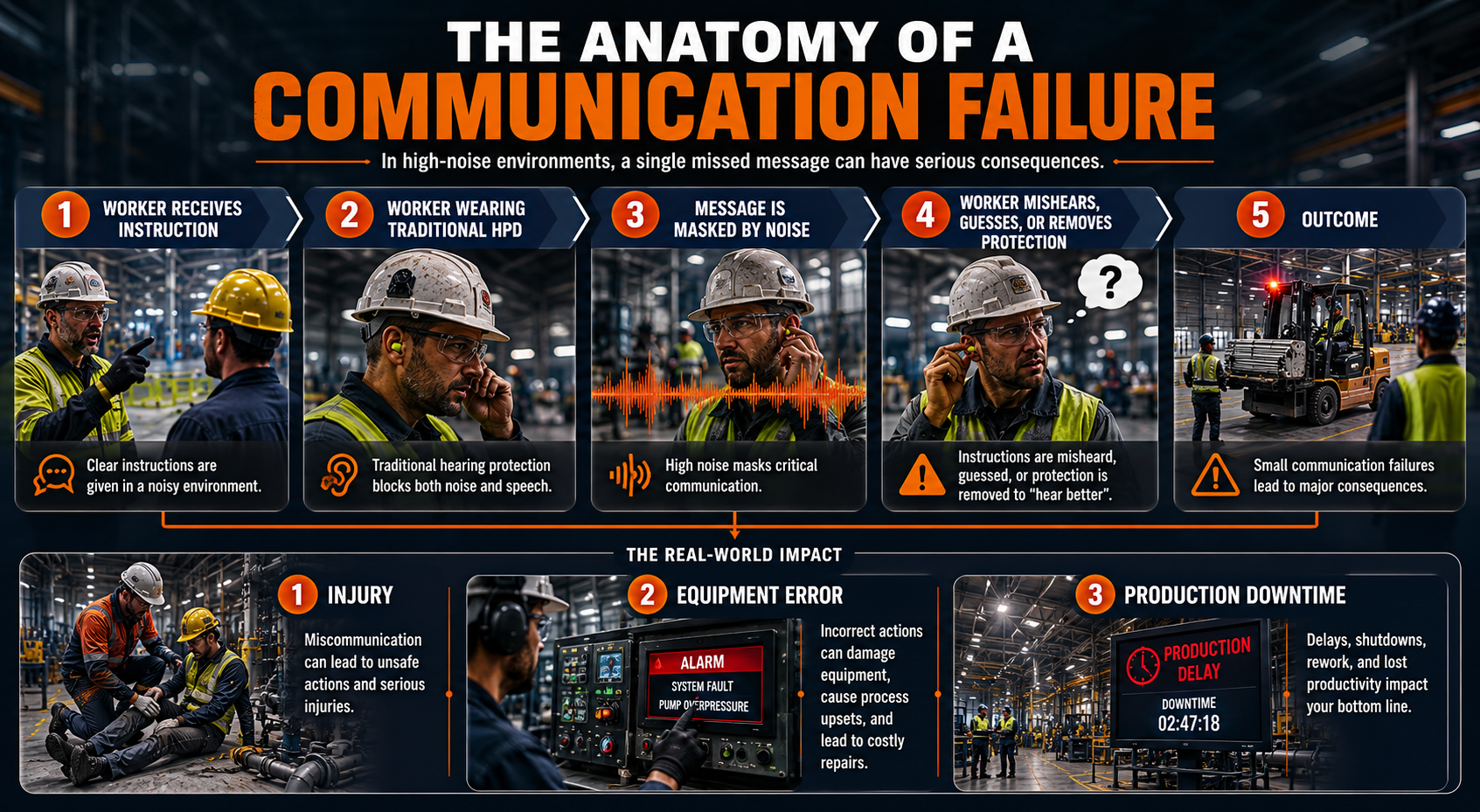
But here's the problem no one talks about loudly enough: the moment a worker puts in traditional hearing protection, they don't just block the noise, they block communication. And when communication fails in an industrial environment, the consequences aren't just inconvenient. They are operationally costly, and they can be fatal.
This article examines the full scope of communication challenges in high-noise workplaces, including the safety risks they create, the operational costs they drive, and why modern industrial operations can no longer afford to treat communication as an afterthought within their hearing conservation strategy.
The Scale of the Problem: Who Is Affected?
“22 million U.S. workers are exposed to hazardous noise at work each year. In the global industrial workforce, the number is in the hundreds of millions. Every one of them faces the same communication dilemma.”
High-noise communication challenges are not unique to one industry. They affect workers across virtually every major industrial sector:
| Industry | Typical Noise Range | Primary Noise Sources |
|---|---|---|
| Manufacturing | 90–100 dB(A) | Assembly lines, stamping presses, CNC machinery |
| Mining | 100+ dB(A); blasts up to 160 dB | Drilling, blasting, heavy haulage |
| Oil & Gas | 90–110 dB(A) | Drilling rigs, compressor stations, LNG processing |
| Aviation & Ground Support | 100–140 dB(A) | Aircraft engines, jet blast, ground support equipment |
| Utilities & Power Generation | 90–105 dB(A) | Turbine halls, transformer stations, generation facilities |
| Rail & Transportation | 85–100 dB(A) | Track maintenance, rail yards, depot operations |
| Food Processing | 85–95 dB(A) | High-pressure washing, conveyors, packaging lines |
| Waste Management & Recycling | 90+ dB(A) | Compactors, shredders, sorting equipment |
| Data Centers | 80–100 dB(A) | Cooling systems, UPS units, AI computing infrastructure |
In each of these environments, workers are legally required to wear hearing protection. And in each of them, that same hearing protection creates a communication barrier that standard PPE was never designed to solve.
What Is High-Noise Communication, and Why Does It Fail?
High-noise communication refers to the exchange of verbal instructions, safety alerts, operational directions, and situational information between workers in environments where ambient noise levels make normal speech unreliable or impossible.
Human speech is typically generated at around 60–70 dB(A). Background noise in many industrial environments exceeds this by 20–40 dB or more, meaning a worker's voice can be literally swallowed by the environment before it reaches the person standing next to them.
The Shouting Threshold and Why It Doesn't Work
OSHA's hearing conservation standard (29 CFR 1910.95) requires hearing protection when noise reaches or exceeds 85 dB(A) as an 8-hour time-weighted average (TWA). Workers commonly attempt to communicate by shouting — but shouting only raises voice level to approximately 80–85 dB(A), still at or below the ambient noise floor in many environments. The result is communication that is either impossible or dangerously unreliable.
The Hearing Protection Removal Problem
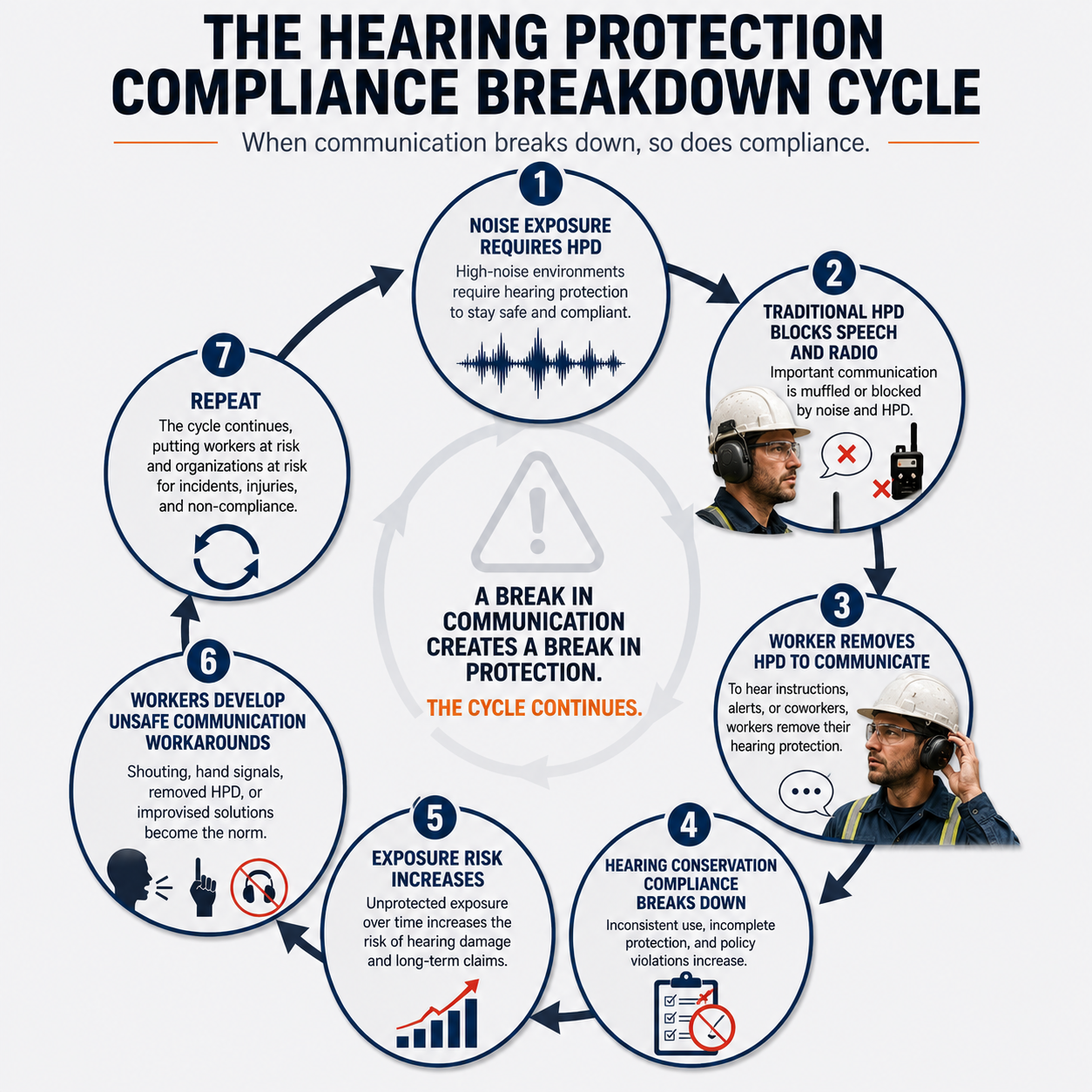
When traditional hearing protection blocks communication, workers face an impossible choice: keep the protection in and miss the instruction, or remove it to hear. Removing hearing protection, even briefly, breaks the continuous protection hearing conservation requires. Worse, it exposes workers to peak impulse noise events that can cause immediate hearing damage. Compliance with hearing protection drops significantly in environments where communication is difficult, creating a compounding risk cycle.
The Noise Floor Has Risen
The industrial noise landscape has become more complex over the past decade. The expansion of AI computing infrastructure, increased automation density on factory floors, the proliferation of large-scale renewable energy facilities, and the ongoing build-out of hyperscale data centers have all introduced new sources of sustained broadband and tonal noise into workplaces. Workers in 2026 often operate in environments with multiple simultaneous noise sources, such as machinery, HVAC systems, conveyors, vehicles, and electronic equipment, creating a more challenging acoustic environment than existed even five years ago.
Communication Is Not a Comfort Feature — It Is a Critical Safety System
In most industrial workplaces, hearing protection is classified as personal protective equipment (PPE) — a tool to protect the individual. Communication is often treated separately, as an operational tool or a management concern. This divide is the root of the problem.
Communication is a safety-critical system. Here's why:
1. Emergency Response Depends on It
Workers who cannot hear or transmit emergency warnings (e.g., equipment failures, gas leaks, fire alerts, evacuation orders, etc.) are unable to respond appropriately. In high-hazard industries like oil and gas, mining, and utilities, the window between warning and catastrophe can be measured in seconds.
2. Situational Awareness Cannot Function Without It
Situational awareness (the ability to perceive, understand, and anticipate conditions in the immediate environment) requires workers to receive and process both auditory and verbal information: the sound of an approaching vehicle, the warning tone of a forklift, a supervisor's instruction to stand clear. Traditional hearing protection that blocks all ambient sound destroys situational awareness.
3. Operational Instructions Drive Every Task
Work is coordinated through communication: shift briefings, equipment changeovers, quality calls, safety alerts, task handoffs, and real-time problem-solving. When those instructions cannot be reliably transmitted or received, the quality and safety of every task they govern is degraded.
4. Human Factors Research Confirms the Link
Research consistently places human factors, including miscommunication, at the center of industrial incidents. Studies suggest that 80–90% of workplace incidents involve human factors, and communication failure is among the most frequently cited contributing causes. In high-risk sectors like oil and gas, the fatality rate from workplace accidents is approximately seven times higher than the average across all industries.
The Operational and Financial Cost of Communication Failures
Workplace Injury Costs
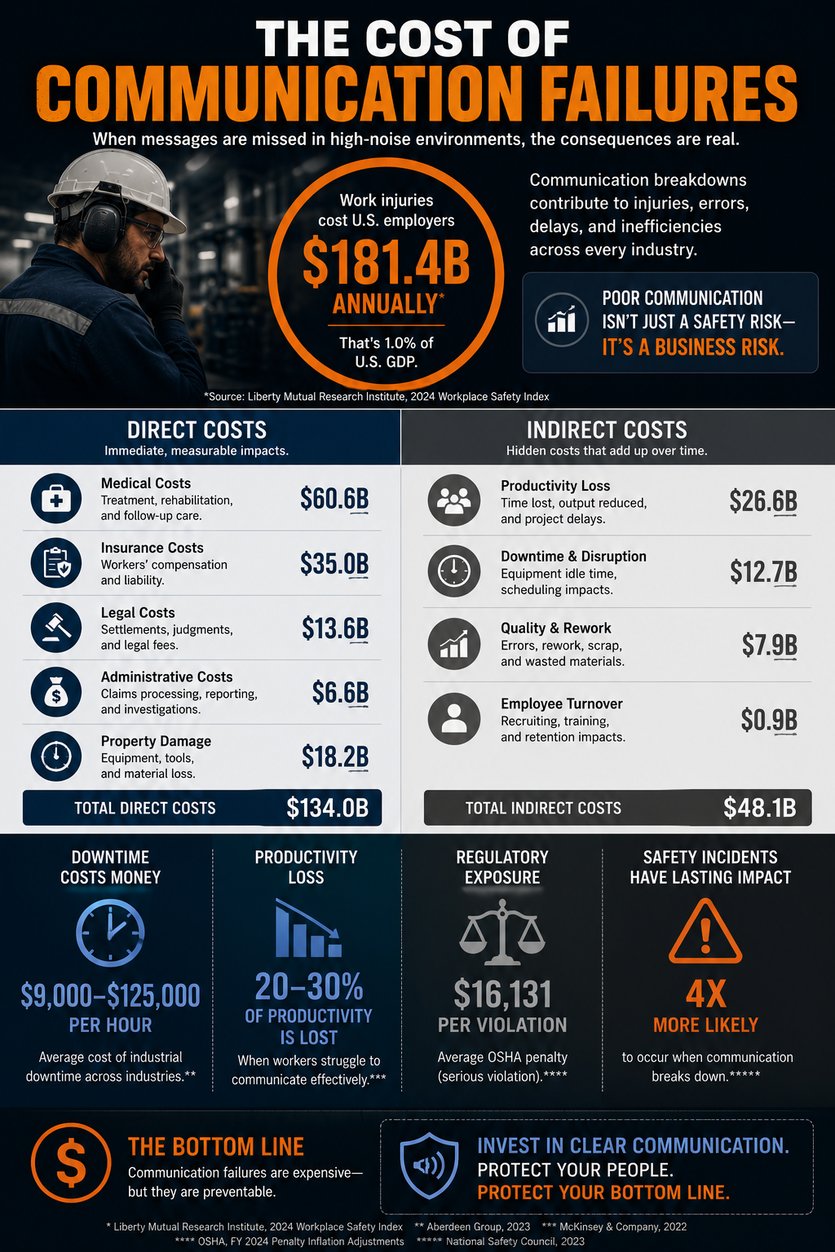
The U.S. National Safety Council estimated the total cost of work injuries in 2024 at $181.4 billion, including $54.9 billion in wage and productivity losses, $36.8 billion in medical expenses, and $64.5 billion in administrative expenses. Employers paid more than $1 billion per week in direct workers' compensation costs for non-fatal disabling injuries. The average cost of a single medically-consulted workplace injury was approximately $43,000.
Indirect costs, including investigation time, retraining, production delays, reputational impact, and regulatory penalties, typically run 4 to 10 times higher than direct costs.
“The total cost of work injuries in the U.S. in 2024 was $181.4 billion. Indirect costs can run 4 to 10 times higher than direct costs. Communication failures are a documented contributing factor in the majority of incidents driven by human error.”
Downtime and Productivity Loss
Communication failures in operational contexts create their own financial exposure, distinct from injury-related costs:
- Missed instructions during equipment changeovers lead to incorrect setups, waste, and rework
- Delayed emergency response extends equipment downtime and increases repair costs
- Unclear task handoffs between shifts create production gaps and quality failures
- Repeated communication attempts (e.g., workers shouting, stopping to remove PPE, waiting for radio responses, etc.) consume significant productive time across a shift
- Reduced worker confidence in environments where communication is unreliable correlates with slower task execution and increased error rates
The Workforce Shortage Multiplier
The communication risk calculus is being compounded by a workforce crisis across the industrial sector. In June 2025, the U.S. alone had more than 415,000 open manufacturing positions. Industry projections suggest that by 2033, nearly half of the 3.8 million new manufacturing jobs required could go unfilled. Nearly one-third of current manufacturing workers are over 55, and retirement attrition is accelerating.
In this environment, fewer and less experienced workers are performing more complex tasks. The margin for communication error shrinks as experience thins. Instructions must be communicated clearly, received accurately, and acted on correctly the first time.
| Cost Category | Description | Estimated Impact |
|---|---|---|
| Direct injury costs | Medical, compensation, lost wages | ~$43,000 per injury (NSC, 2023) |
| Indirect injury costs | Retraining, investigation, downtime | 4–10× direct costs |
| Production downtime | Equipment errors, rework, delays | Significant in lean operations |
| Regulatory penalties | OSHA violations, non-compliance costs | Variable; can include program shutdown |
| Attrition & morale | Workers leaving unsafe conditions | Long-term recruitment/retention cost |
| Incident investigation | Management time, legal exposure | Often unmeasured but substantial |
Regulatory Landscape: What the Standards Require
OSHA Hearing Conservation Standard (29 CFR 1910.95)
In the United States, OSHA's hearing conservation standard requires employers to implement a hearing conservation program when workers are exposed to noise at or above 85 dB(A) as an 8-hour TWA (the action level). The permissible exposure limit (PEL) is 90 dB(A). At the action level, employers must provide:
- Noise monitoring and measurement
- Baseline and annual audiometric testing
- Hearing protection devices at no cost, in a variety of styles
- Annual training on noise hazards and HPD use
- Record keeping for exposure data and audiograms
What OSHA's standard does not explicitly address is the communication dimension of hearing protection compliance — the practical reality that requiring workers to wear hearing protection without providing a communication solution creates a safety risk of its own.
EU Directive 2003/10/EC
The European Union's Directive 2003/10/EC on minimum health and safety requirements regarding exposure to physical agents (noise) establishes:
- Lower exposure action value: 80 dB(A) — hearing protection must be made available; information and training required
- Upper exposure action value: 85 dB(A) — hearing protection must be worn; health surveillance required
- Exposure limit value: 87 dB(A) — accounting for HPD attenuation; this level must not be exceeded
International Standards
Standards from Safe Work Australia, the UK Health and Safety Executive (HSE), and the International Labour Organization (ILO) align with OSHA and EU frameworks in their core noise exposure thresholds. The ILO reports nearly 2.78 million annual occupational fatalities globally, with human factors including communication failures among the recognized contributing causes.
| Region / Standard | Action Level | Exposure Limit | HPD Required At |
|---|---|---|---|
| USA — OSHA 29 CFR 1910.95 | 85 dB(A) TWA | 90 dB(A) | 85 dB(A) |
| EU — Directive 2003/10/EC | 80 dB(A) lower / 85 dB(A) upper | 87 dB(A) | 85 dB(A) upper |
| Australia — Safe Work Australia | 85 dB(A) | 85 dB(A) | 85 dB(A) |
| UK — Control of Noise at Work 2005 | 80 dB(A) lower / 85 dB(A) upper | 87 dB(A) | 85 dB(A) upper |
| Canada — Provincial standards | 85 dB(A) most provinces | 90 dB(A) most provinces | 85 dB(A) most provinces |
Why Traditional Hearing Protection Fails the Communication Test
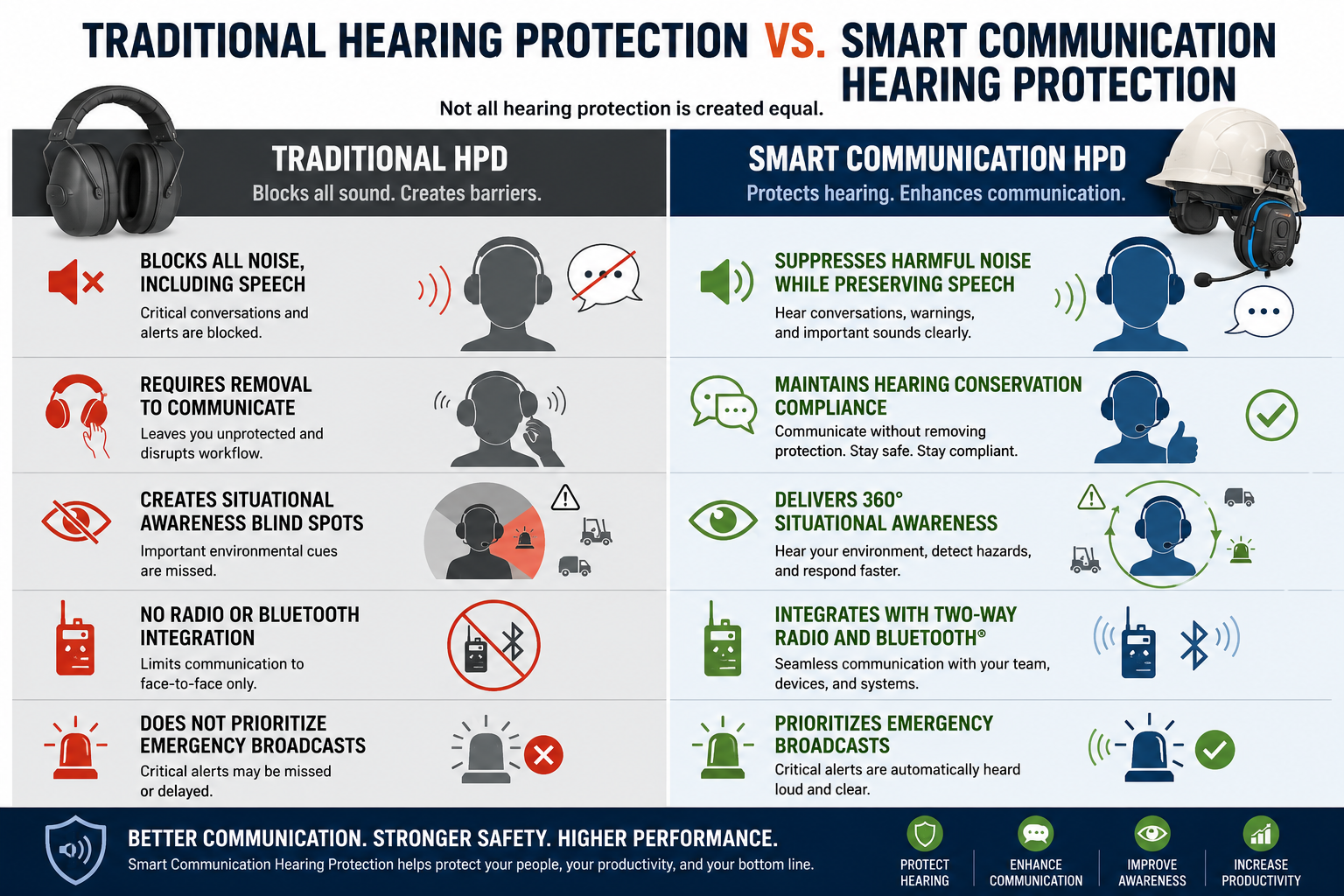
Standard hearing protection (e.g., foam earplugs, passive earmuffs, or banded protectors) was engineered to reduce the amount of sound that reaches the eardrum. It does this by attenuating all sound indiscriminately, regardless of whether that sound is harmful noise or a critical safety instruction. This creates several well-documented problems:
The Occlusion Effect
Traditional hearing protection can create the perception that the wearer's own voice is muffled or distorted, disrupting their ability to modulate speech volume and making face-to-face communication difficult even in moderately loud environments.
Radio Communication Degradation
Workers who rely on two-way radios for coordination find that standard earmuffs block or muffle radio transmissions, forcing them to either increase radio volume (which can itself cause hearing damage) or remove the HPD to hear. Neither option is acceptable.
Directional Sound Loss
Passive hearing protection eliminates the directional hearing cues the human auditory system relies on to locate the source of sounds (e.g., an approaching vehicle, a pressure release, a person calling out, etc.). This loss of directional awareness is a recognized safety risk in environments with moving equipment.
Behavioral Non-Compliance
When hearing protection prevents effective communication, workers simply stop wearing it consistently. A worker who removes their hearing protection for just 30 minutes during an 8-hour shift loses approximately 40% of the protection provided for the day, potentially exceeding regulatory exposure limits even when protection was technically "provided."
Alarm and Warning Signal Masking
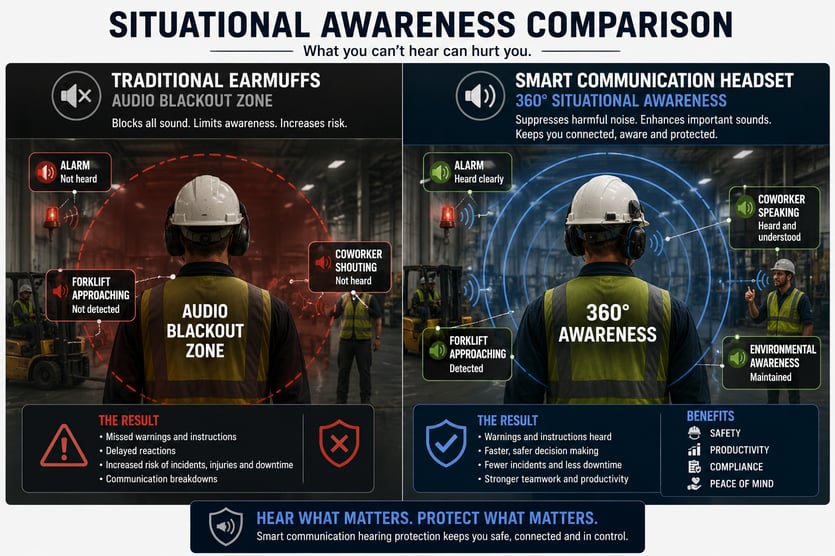
Industrial facilities rely on auditory alarm systems (e.g., evacuation sirens, gas detection alerts, equipment fault tones, vehicle backup alarms, etc.). Traditional hearing protection attenuates these signals, potentially preventing workers from detecting critical warnings in time to respond.
Situational Awareness: The Communication Capability That Can Save Lives
Situational awareness in an industrial context means a worker's ability to perceive what is happening around them (not just what they can see, but what they can hear) and to use that perception to anticipate hazards and make safe decisions.
Sound is a primary input channel for situational awareness. Workers use sound to:
- Detect approaching forklifts, overhead cranes, or haul trucks
- Identify changes in equipment behavior (e.g., unusual vibrations, pitch shifts, irregular cycles, etc.)
- Register audible safety alarms (e.g., gas detection, fire suppression activation, emergency sirens, etc.)
- Locate colleagues in low-visibility environments affected by dust, steam, or physical barriers
- Respond to verbal warnings shouted in real time
When traditional hearing protection eliminates these inputs, situational awareness collapses. Workers who cannot hear their environment operate in a partial sensory blackout, relying solely on vision in environments where visual range is often limited by physical barriers, equipment, distance, or environmental conditions.
Vehicle-pedestrian interactions remain among the most common causes of serious and fatal workplace injuries in high-noise industrial environments globally. Many of these incidents involve workers wearing appropriate hearing protection, who simply did not hear the vehicle in time because their protection offered no mechanism for preserving ambient sound awareness.
See how SENS® Technology solves the hearing protection vs. communication trade-off.
Explore SENS® Technology →The Modern Industrial Environment: New Pressures on Communication Safety
The communication challenges of high-noise workplaces are not static. In 2026, they are being intensified by a converging set of operational trends.
Automation and Robotics Density
The expansion of automation on production floors has reduced the number of workers per square meter while increasing the density and variety of noise-generating equipment. Workers who remain on the floor are frequently responsible for overseeing multiple automated systems simultaneously — a role that depends heavily on auditory monitoring. A worker who cannot hear an anomalous equipment noise because their hearing protection blocks it may miss the first warning sign of a failure that causes injury, unplanned downtime, or a quality event.
AI-Driven Infrastructure and Data Centers
The global buildout of hyperscale and AI computing infrastructure has created a new class of high-noise industrial environment. Large data centers, particularly those hosting high-density GPU clusters for AI workloads, require massive cooling systems that generate continuous broadband noise at levels that can approach or exceed occupational exposure limits. Maintenance technicians and operations staff working in these environments face the full range of communication challenges common to traditional heavy industry, often without the same established hearing conservation culture.
Connected Worker Initiatives
The connected worker technology market is projected to grow from $8.62 billion in 2025 to $20.18 billion by 2030, driven by industrial digitalization, safety-focused wearables, and pressure to reduce downtime. Connected worker platforms deliver real-time safety alerts, task assignments, equipment status, and performance metrics to frontline workers, but these communication flows are only valuable if workers can receive them. In high-noise environments, a worker whose hearing protection isolates them from audio alerts is effectively disconnected from the connected worker ecosystem.
Productivity and Efficiency Expectations
Modern industrial operations are under sustained pressure to reduce waste, increase throughput, and achieve more with constrained headcounts. In lean and just-in-time production models, even small communication-driven delays have downstream effects on output and cost. The margin for misheard instructions or repeated requests for clarification has never been smaller.
Increasing Complexity of Safety-Critical Tasks
As industrial facilities adopt more complex technology (e.g., advanced process control systems, predictive maintenance platforms, integrated safety instrumentation, etc.), the tasks workers perform are increasingly reliant on clear, accurate communication. A misheard parameter during a control room handoff or an unheard emergency broadcast during a process upset can have consequences that simpler operations of a previous era would not have faced.
“The connected worker market is projected to reach $20.18 billion by 2030. But connected worker technology only delivers its value if workers on the floor can actually receive the communications it generates. In high-noise environments, that requires more than a smartphone.”
What Good High-Noise Communication Looks Like: The Modern Standard
The technology to eliminate the false choice between hearing protection and communication is proven, available, and increasingly cost-effective. Modern smart communication hearing protection addresses each failure mode that traditional HPD creates.
Noise-Selective Speech Enhancement
Advanced digital signal processing allows smart headsets and earplugs to distinguish between harmful noise frequencies and speech frequencies. By suppressing harmful broadband, impulse, and tonal noise while preserving and amplifying speech, these systems enable face-to-face communication at normal conversational volumes while maintaining full hearing protection compliance. This is purpose-built industrial technology, not consumer noise cancellation adapted for a worksite.
Safe Output Limiting
Smart hearing protection devices limit the maximum output level reaching the ear to a safe level, typically 82 dB(A), regardless of input noise level. Workers can increase radio or communication volume without risk of hearing damage, maintaining clear reception in extreme noise environments up to 120 dB(A) and beyond.
360° Binaural Situational Awareness
Binaural microphone arrays capture ambient sound from all directions and reintroduce it to the wearer at a safe level. This preserves the directional hearing cues that passive hearing protection destroys, allowing workers to detect the direction and distance of approaching vehicles, equipment changes, and audible alarms, while remaining fully protected from noise-induced hearing damage.
Integrated Multi-Modal Communication
Modern industrial communication headsets integrate with:
- Two-way radios (digital and analog) — priority integration ensures emergency broadcasts are always heard
- Bluetooth-enabled devices — smartphones, tablets, control room systems
- Short-range peer-to-peer communication — headset-to-headset communication without a radio, up to 150 feet
- PTT (Push-to-Talk) systems — optimized for fast, hands-free coordination
Hazardous Location and Extreme Noise Ratings
For operations in classified hazardous locations, ATEX, IECEx, UL, and CSA-certified intrinsically safe communication headsets meet the electrical and mechanical requirements for environments where flammable gases, vapors, or dusts may be present. For the most extreme noise environments, dual-protection headsets combine an over-the-ear cup with an inner earplug insert for maximum attenuation without sacrificing communication performance.
Industry-Specific Communication Challenges
Manufacturing
Manufacturing floors combine multiple simultaneous noise sources with high communication demands across shift teams, maintenance crews, and quality personnel. Workforce shortages mean individual workers are covering more ground and more tasks, raising the stakes for accurate first-pass communication. Connected worker deployments are increasing on production floors, but only reach workers if the communication layer functions through hearing protection.
Key risks: Missed quality instructions, unheard machine fault alarms, vehicle-pedestrian incidents, coordination failures during equipment changeovers.
Mining
Mining operations present some of the most acoustically hostile environments in industry. Surface operations involve heavy haulage equipment generating sustained broadband noise across large areas. Emergency communication in mining has a direct life-safety function: workers who cannot receive a gas alarm, a roof instability warning, or an evacuation order face extreme personal risk.
Key risks: Blast warning communication, emergency evacuation, proximity alerts for heavy equipment, confined space communication.
Oil & Gas
Oil and gas operations require continuous verbal coordination across large facilities (compressor stations, processing trains, wellheads, and terminals). Workers routinely operate in environments that combine extreme noise with classified hazardous locations, requiring communication solutions that are both functionally effective and intrinsically safe. The industry's fatality rate is approximately seven times higher than the average across all industries.
Key risks: Process upset communication, permit-to-work instruction transmission, emergency shutdown coordination, shift handoff accuracy.
Aviation
Ground support operations at airports represent one of the most acoustically extreme work environments in any industry. Aircraft engine startup, jet blast, and ground support equipment create noise environments reaching 140 dB(A) at close range. Simultaneous coordination across ground crews, de-icing teams, fueling personnel, baggage handlers, and pushback operators requires reliable communication channels where shouting is completely ineffective.
Key risks: FOD detection, pushback/tow instruction accuracy, fuel loading coordination, emergency response on the apron.
Utilities
Power generation and transmission infrastructure (turbine halls, substation switchyards, cooling towers, and distribution facilities) exposes workers to sustained high-noise levels during both routine operations and fault response activities. Emergency communication during grid events requires clarity and reliability that standard hearing protection cannot support.
Key risks: Fault response coordination, switching instruction accuracy, confined space work communication, high-voltage proximity awareness.
Rail
Track maintenance, depot operations, and signal work expose rail workers to high-noise environments combined with significant struck-by risks from passing trains and on-track plant. The margin for error in live rail environments is extremely low, and the consequences of misheard track possession instructions or incorrect signal information are severe.
Key risks: Track possession communication, on-track plant coordination, signal and control communication accuracy.
Food Processing
Food processing environments combine high noise from processing, conveyance, and high-pressure cleaning with stringent hygiene requirements that limit PPE options. Communication demands are high during changeovers, quality checks, and sanitation activities. Language diversity in processing workforces further complicates communication reliability.
Key risks: Allergen and quality instruction communication, changeover coordination, cleaning schedule communication, new worker onboarding.
Waste Management & Recycling
Compactors, shredders, sorting equipment, and heavy vehicles create high-noise environments where workers also face significant struck-by and caught-in hazards. Radio communication between equipment operators and ground workers is operationally and safety-critical simultaneously.
Key risks: Equipment proximity communication, load clearance coordination, emergency response in high-traffic areas.
Data Centers
The data center sector represents a rapidly growing high-noise environment that has not yet developed the same hearing conservation culture as traditional heavy industry. Modern hyperscale facilities, particularly those hosting AI computing infrastructure with high-density GPU clusters, require massive cooling capacity generating continuous broadband noise at levels that can exceed the OSHA action level. Maintenance and operations staff need to communicate with remote NOC teams, transmit safety-critical information during maintenance windows, and maintain situational awareness around high-voltage and thermal hazards, all while wearing hearing protection.
Key risks: Maintenance window coordination, hot-swap procedure communication, emergency shutdown instruction accuracy, situational awareness around high-voltage and thermal hazards.
Not sure which communication hearing protection is right for your environment?
Use the Headset Selector Tool →How Sensear Addresses the High-Noise Communication Challenge
Sensear designs smart communication headsets and earplugs specifically for industrial high-noise environments, integrating certified hearing protection with advanced communication capability in a single device.
SENS® Technology: Speech Enhancement and Noise Suppression
Sensear's proprietary SENS® (Speech Enhancement, Noise Suppression) Technology analyzes the acoustic environment in real time, classifying incoming sound by frequency and type (broadband noise, impulse noise, and tonal noise) and applying selective suppression to harmful frequencies while preserving and enhancing speech. The result: a hearing protection device that limits output to the ear to a safe maximum of 82 dB(A) in noise environments up to 105 dB(A) (standard models) or 120 dB(A) (extreme noise dual-protection models), while simultaneously delivering clear, intelligible communication.
360° Binaural Situational Awareness
SENS® Technology uses binaural processing to preserve directional sound cues, delivering 360° situational awareness that allows wearers to detect and locate surrounding hazards (e.g., approaching vehicles, alarms, equipment changes, etc.) without removing their hearing protection.
Multiple Communication Modes
Sensear devices support face-to-face communication, two-way radio integration (digital and analog), Bluetooth® connectivity to mobile devices and communication systems, and short-range headset-to-headset communication, enabling teams to coordinate across all operational scenarios without compromising hearing protection compliance.
Emergency Broadcast Priority
In radio-integrated configurations, Sensear headsets prioritize incoming two-way radio transmissions over other audio sources, ensuring that emergency broadcasts are always received clearly — a critical capability in any facility where audible alerts drive emergency response.
Intrinsically Safe and Extreme Noise Options
For classified hazardous locations, Sensear offers ATEX, IECEx, UL, and CSA-certified intrinsically safe headsets. For the most extreme noise environments, Sensear's dual-protection headsets combine an outer earcup with an inner earplug insert for maximum attenuation without sacrificing communication performance.
2026 and Beyond: Communication Safety as a Strategic Priority
The industrial landscape of 2026 is not the same as it was when most occupational noise standards were written. The intersection of workforce shortages, automation density, connected worker technology, AI-driven infrastructure, and increasing operational complexity has raised the bar for what "adequate" high-noise communication looks like.
Organizations that treat hearing protection and communication as separate, siloed problems will continue to experience the safety incidents, operational errors, and productivity losses that come from that gap. Organizations that recognize communication as a safety-critical system, and invest in solutions that address both simultaneously, are building the operational resilience and workforce safety capability that modern industrial environments demand.
The technology to close this gap is proven, available, and increasingly cost-effective. The question for safety managers, operations leaders, and EHS professionals is no longer whether to solve the problem, but when.
Frequently Asked Questions
What is a communication failure in a high-noise workplace?
A communication failure in a high-noise workplace occurs when a worker is unable to clearly send or receive verbal instructions, safety warnings, or operational information because of excessive ambient noise. This can happen because noise levels exceed the volume of human speech, because the worker is wearing hearing protection that blocks all sound, or because background noise degrades radio transmissions to the point of unintelligibility. Communication failures in high-noise environments are a recognized contributing factor in industrial safety incidents and production errors.
Why is communication difficult when wearing hearing protection?
Traditional hearing protection (foam earplugs or passive earmuffs) attenuates all sound, including both harmful noise and human speech. This non-selective attenuation makes it difficult or impossible for workers to have face-to-face conversations, receive radio transmissions clearly, or hear audible alarms while wearing their hearing protection. Workers often face an impossible choice between hearing conservation compliance and the ability to communicate safely.
What are the safety risks of poor communication in high-noise industrial environments?
Poor communication in high-noise environments creates multiple safety risks: missed emergency alarms or evacuation instructions, failure to hear proximity warnings from approaching vehicles or overhead equipment, misheard task instructions leading to equipment errors or unsafe actions, reduced situational awareness in hazardous environments, and non-compliance with hearing protection requirements when workers remove PPE to communicate. Research suggests 80–90% of workplace incidents involve human factors, and communication failure is a recognized contributing element.
What is situational awareness in industrial safety?
Situational awareness in industrial safety refers to a worker's ability to perceive, understand, and anticipate conditions in their immediate environment, including both visual and auditory inputs, in order to identify and respond to hazards. Sound is a primary input channel for situational awareness. Traditional hearing protection that blocks all ambient sound significantly degrades this awareness, which is why modern smart hearing protection is designed to preserve critical environmental sounds while suppressing harmful noise.
What does OSHA require for hearing conservation?
OSHA's hearing conservation standard (29 CFR 1910.95) requires employers to implement a hearing conservation program when workers are exposed to noise at or above 85 dB(A) as an 8-hour time-weighted average. This includes noise monitoring, audiometric testing, hearing protection devices at no cost, annual training, and recordkeeping. The permissible exposure limit (PEL) is 90 dB(A). Workers in manufacturing, mining, oil and gas, aviation, and construction routinely operate in environments that meet or exceed these thresholds.
What does EU Directive 2003/10/EC require for noise at work?
EU Directive 2003/10/EC establishes a lower exposure action value of 80 dB(A), at which hearing protection must be made available; an upper exposure action value of 85 dB(A), at which hearing protection must be worn; and an exposure limit value of 87 dB(A), accounting for HPD attenuation, which must not be exceeded. The Directive also requires risk assessment, health surveillance for workers above the upper action value, and noise reduction at source where feasible.
How many workers are exposed to hazardous noise at work?
The CDC estimates 22 million U.S. workers are exposed to hazardous noise at work each year. The WHO attributes 16% of all disabling hearing loss in adults to occupational noise exposure. Globally, occupational noise-induced hearing loss accounted for nearly 7.85 million disability-adjusted life years (DALYs) in 2021, more than double the figure from 1990.
What is smart hearing protection for industrial use?
Smart hearing protection for industrial use combines certified noise attenuation with active audio processing to enable communication while maintaining protection compliance. Unlike passive hearing protection, smart devices use digital signal processing to suppress harmful noise while preserving speech, deliver situational awareness through binaural ambient sound reproduction, and integrate with two-way radios and Bluetooth® systems, allowing workers to communicate at normal conversational volumes without removing their hearing protection.
What is the difference between noise cancellation and speech enhancement in hearing protection?
In industrial hearing protection, noise cancellation uses active noise control (destructive interference) to reduce ambient noise, common in consumer headphones but limited against the high-level broadband noise found in industry. Speech enhancement (as used in Sensear's SENS® Technology) uses digital signal processing to analyze the acoustic environment in real time, classify sound by type and frequency, suppress harmful noise, and selectively amplify speech frequencies. Speech enhancement is purpose-engineered for industrial noise environments.
How does communication hearing protection support connected worker programs?
Connected worker programs deliver real-time information (e.g., safety alerts, task assignments, equipment status, emergency notifications, etc.) to frontline workers. In high-noise environments, this is only effective if workers can actually receive it. Smart communication hearing protection devices that integrate with Bluetooth® systems, PTT platforms, and radio networks allow workers to participate fully in connected worker programs without removing their hearing protection, ensuring that digital safety and productivity benefits reach the workers who need them most.
Which industries face the highest risk from communication failures in noise?
Industries with the highest risk include: oil and gas (fatality rate ~7× the cross-industry average), underground mining (extreme noise, evacuation communication critical), aviation ground support (noise up to 140 dB(A), complex crew coordination), heavy manufacturing (sustained high-noise with frequent task instructions), and utilities/power generation (emergency response in high-consequence environments). Any industry combining sustained noise above 85 dB(A) with high-consequence tasks requiring verbal coordination faces significant risk from communication failures.
Conclusion: Communication is a Safety System, so Treat It Like One
Noise-induced hearing loss (NIHL) is a well-understood occupational health risk. Hearing protection is mandated by law across every major industrial jurisdiction. And yet, the communication failure that traditional hearing protection creates (the gap between what workers need to hear and what they can hear) remains one of the most consistently underaddressed safety and operational risks in industry.
The cost of getting this wrong is not hypothetical. It shows up in workplace incident investigations, production downtime reports, quality failure analyses, and the aggregate toll of $181.4 billion in annual work injury costs in the U.S. alone. It shows up in the workers who remove their hearing protection because they need to communicate, and in the hearing damage, the isolation, and the safety incidents that follow.
The solution is not to accept the trade-off. The technology to eliminate it exists: smart communication hearing protection that protects hearing, preserves situational awareness, enables clear communication, and integrates with the operational and connected worker systems that industrial operations run on.
In 2026, the question is not whether industrial workplaces need better communication solutions. The question is whether organizations are willing to close the gap before the gap closes in on them.
Ready to eliminate the communication-protection trade-off in your facility?
Speak with a Sensear specialist or explore the full product range.
Request a Quote → Download Product Catalog →Related Resources
- What Is SENS® Technology? Speech Enhancement & Noise Suppression
- Dual Protection Hearing Conservation Headsets
- Intrinsically Safe Communication Headsets for Hazardous Locations
- Data Center Noise Hazards: Why Hearing Protection and Communication Matter More Than Ever
- How Effective Is Your Hearing Protection?
- Situational Awareness Blog Articles
- Headset Selector Tool
- Hearing Protection Calculator