Last updated for 2026. This article has been substantially revised to reflect current OSHA, NIOSH, EU, and ISO guidance, modern hearing protection technology, and the realities of today's connected, automated, and aging industrial workforce.
A worker wearing earplugs doesn't hear the forklift backing up behind them. A technician with earmuffs misses a radio call warning of a pressure release two bays over. A new hire, six weeks into the job, doesn't recognize the site's evacuation alarm because it's been muffled into background hum.
None of these workers did anything wrong. Their hearing protection was doing exactly what it was designed to do: blocking noise. The problem is that traditional hearing protection doesn't distinguish between harmful noise and critical sounds, such as alarms, shouted warnings, approaching vehicles, or a colleague calling for help.
This is the situational awareness gap, and in 2026, it's one of the most overlooked risks in industrial safety programs. As workplaces become louder, more automated, and more short-staffed, the question isn't whether workers should wear hearing protection — they must. The real question is whether that protection helps them stay aware, or quietly cuts them off from the world around them.
The short answer: yes, situational awareness and hearing protection can coexist, but only with the right approach and technology. This guide explains what situational awareness means in industrial settings, why it's a core safety requirement (not a "nice to have"), and how modern hearing conservation programs are evolving to protect hearing and awareness at the same time.
Can you have situational awareness while wearing hearing protection?
Yes. While traditional earplugs and earmuffs reduce all sound equally, including alarms, voices, and warning signals, modern hearing protection technologies use speech enhancement and noise suppression to block harmful noise while amplifying critical sounds. This allows workers to stay protected from noise-induced hearing loss without losing awareness of hazards, alarms, or communication in their environment.
1. What Is Situational Awareness in the Workplace?
Situational awareness is the ability to perceive what is happening around you, understand what it means, and anticipate what will happen next quickly enough to respond safely.
In industrial settings, this includes hearing approaching vehicles, recognizing alarms, understanding spoken warnings, and noticing changes in the sound of equipment that might signal a malfunction.
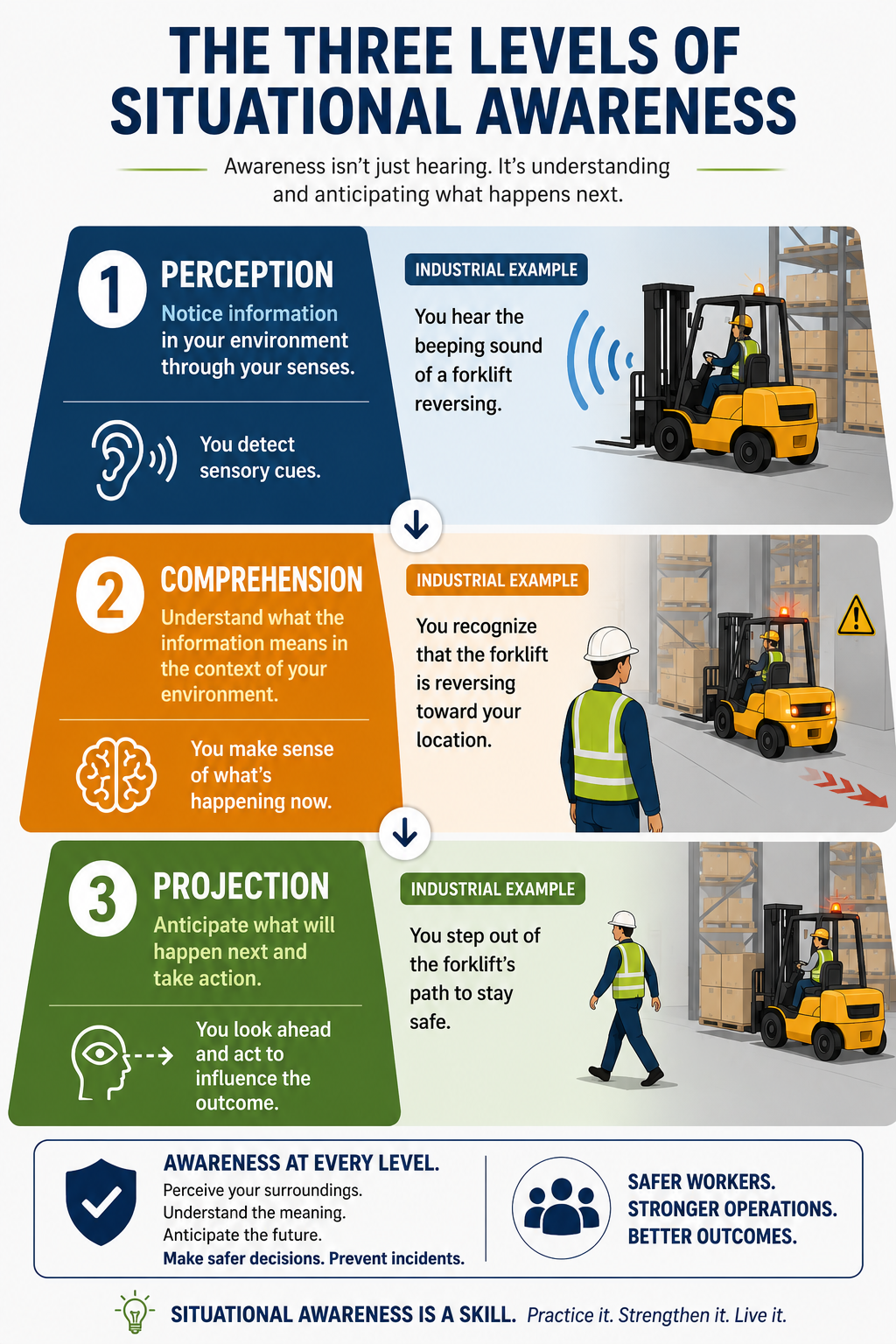
The Three Levels of Situational Awareness
Situational awareness is typically broken into three levels, originally defined in human factors research and widely applied in aviation, mining, and process safety:
- Level 1 — Perception: Detecting relevant cues in the environment (an alarm, a shout, the pitch change of a machine).
- Level 2 — Comprehension: Understanding what those cues mean (that alarm means evacuate; that shout is a warning, not a greeting).
- Level 3 — Projection: Anticipating what will happen next and acting accordingly (a reversing vehicle will pass through this walkway in the next few seconds).
Why Situational Awareness Matters More in 2026
Industrial environments today are more complex than they were even five years ago:
- Aging workforces mean more workers nearing retirement age, who may already have age-related hearing decline (presbycusis), compounding noise-induced hearing loss risk.
- Workforce shortages mean less-experienced workers are operating in high-noise areas sooner, often without years of "tribal knowledge" about site hazards.
- Automation and autonomous equipment (e.g., autonomous haul trucks, AGVs, robotic arms, etc.) move differently than human-operated equipment and don't always announce themselves the way a person would.
- AI-driven operations and remote monitoring are changing how alerts reach workers, often through digital channels that compete with or get lost behind hearing protection.
- Operational efficiency pressure means fewer workers covering more ground, increasing the consequences of a missed warning.
In this environment, situational awareness isn't a soft skill. It's an operational safety control, and it depends heavily on hearing.
2. The Hidden Cost of Traditional Hearing Protection
What Is "Acoustic Tunnel Vision"?
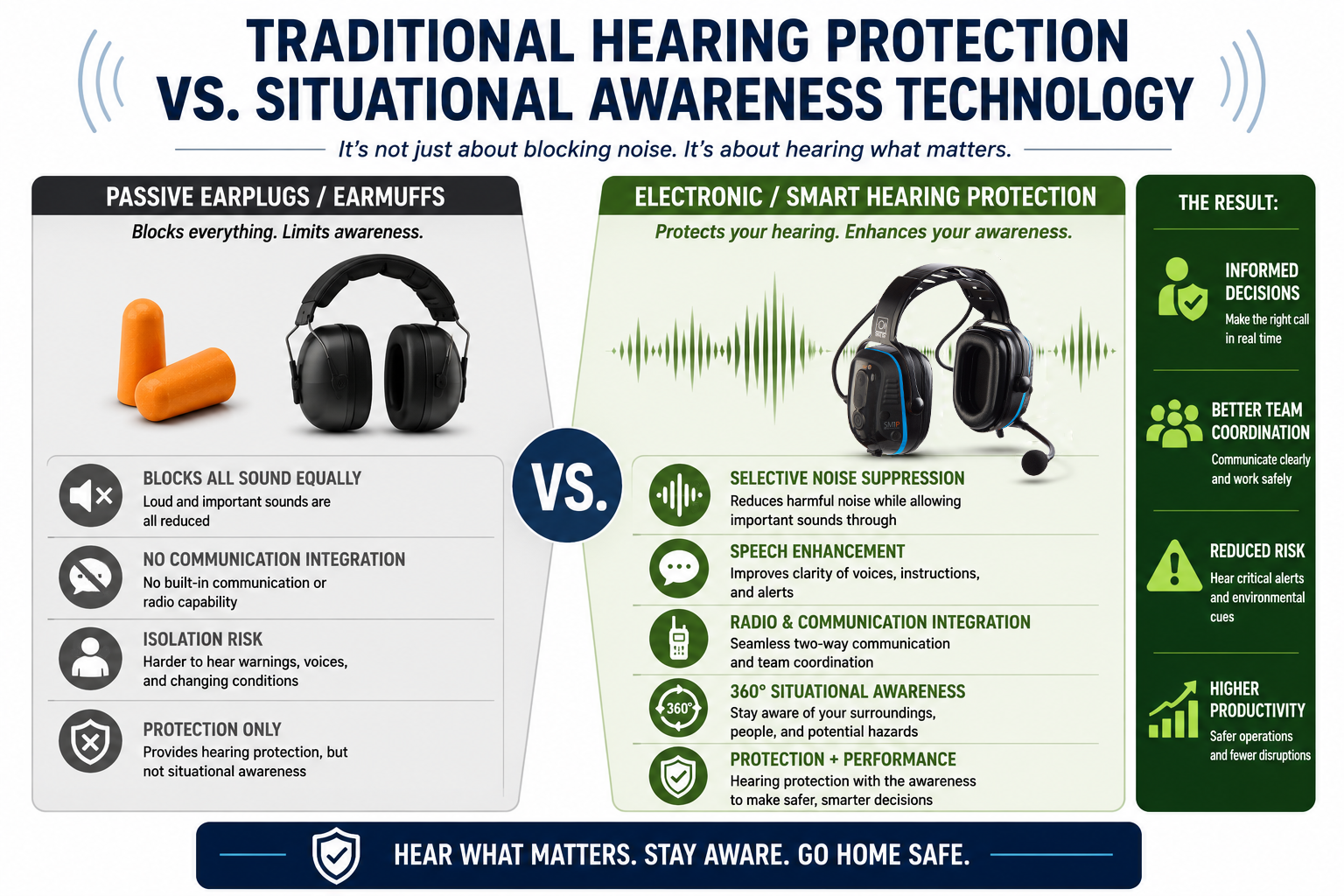
Acoustic tunnel vision describes the effect of traditional hearing protection devices (HPDs), such as foam earplugs and passive earmuffs, that indiscriminately attenuate all sound, including the alarms, warnings, and conversations workers need to hear, not just harmful noise.
Passive hearing protectors are rated by their Noise Reduction Rating (NRR) or Single Number Rating (SNR), and they do this job well for noise overall. But sound doesn't come pre-sorted into "harmful" and "important" categories. A 95 dB alarm and a 95 dB compressor hum are attenuated identically by a passive earplug.
The result: workers who follow PPE policy correctly can still miss the exact signals their safety depends on.
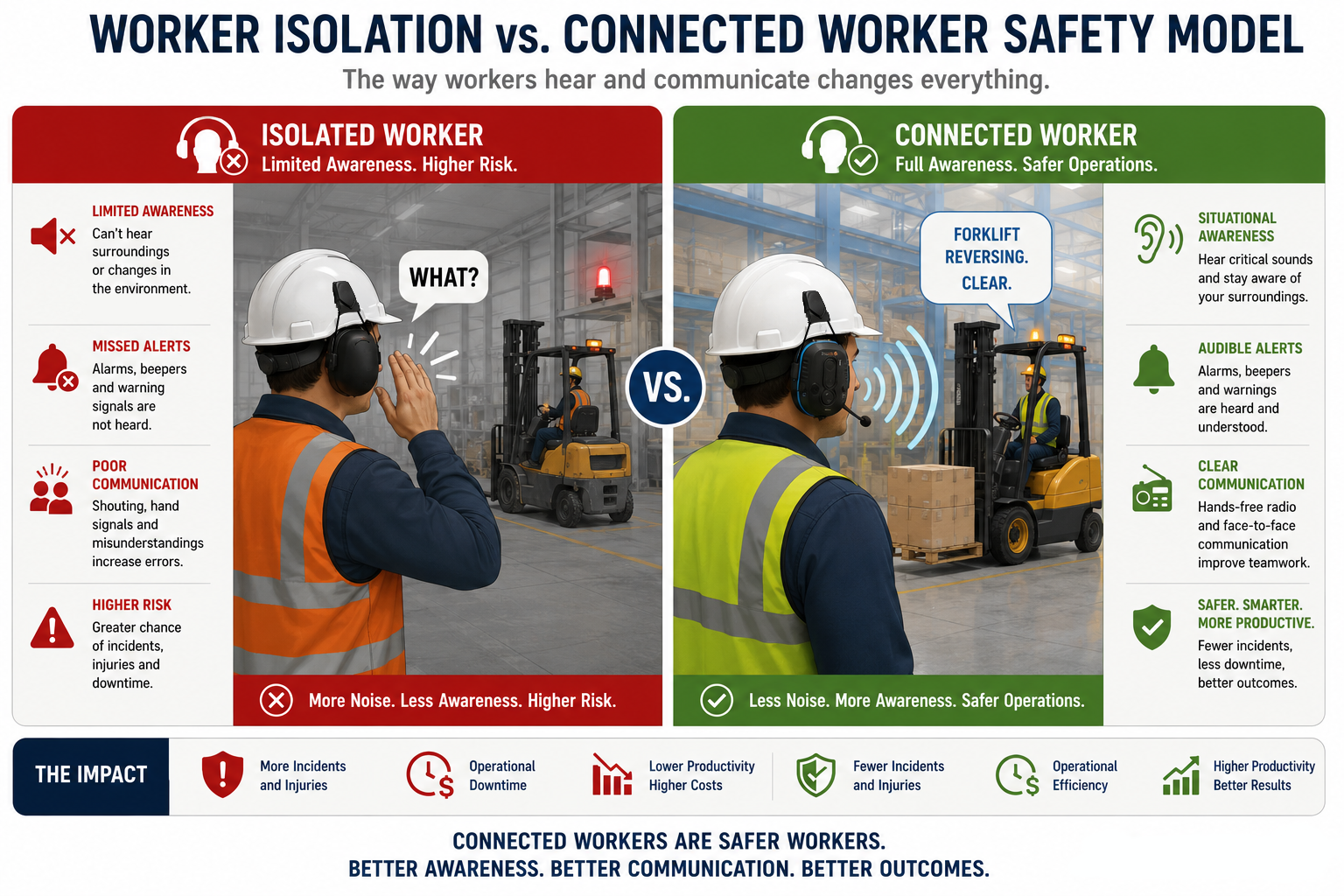
Worker Isolation: A Safety Risk in Itself
Beyond missed alarms, traditional hearing protection contributes to a less obvious but equally serious problem: isolation.
- Workers can't hear colleagues approaching, leading to startle injuries and collisions.
- Face-to-face communication breaks down, so workers shout, remove PPE to talk, or simply stop communicating, each of which introduces risk.
- New or temporary workers feel disconnected from team coordination, slowing their integration into site safety culture.
- Supervisors lose the ability to verbally redirect workers in real time during developing hazards.
"Globally, 1.5 billion people live with some degree of hearing loss, and noise-induced hearing loss remains one of the most preventable occupational illnesses in the world." — World Health Organization, World Report on Hearing
3. Why Hearing Conservation and Situational Awareness Must Work Together
What Is a Hearing Conservation Program?
A hearing conservation program (HCP) is a structured set of policies and practices designed to prevent occupational noise-induced hearing loss. In the U.S., OSHA requires an HCP whenever workers are exposed to an average of 85 decibels (dBA) or more over an 8-hour workday (the "action level").
Global Regulatory Landscape
Hearing conservation isn't just a U.S. requirement, it's a global standard with regional variations:
- OSHA (United States): Under 29 CFR 1910.95, employers must implement a hearing conservation program at the 85 dB(A) action level (8-hour TWA), with a permissible exposure limit (PEL) of 90 dB(A). Required elements include noise monitoring, audiometric testing, hearing protection at no cost to employees, annual training, and recordkeeping.
- NIOSH (United States): NIOSH recommends a more conservative exposure limit of 85 dB(A) as a full-shift TWA using a 3 dB exchange rate (rather than OSHA's 5 dB rate), reflecting stronger evidence on cumulative noise damage.
- EU Directive 2003/10/EC: Sets exposure action values at 80 dB(A) (lower action value) and 85 dB(A) (upper action value), with an exposure limit value of 87 dB(A), and requires hearing protection to be made available at the lower threshold and mandatory at the upper threshold.
- HSE (United Kingdom): The Control of Noise at Work Regulations 2005 mirror the EU framework, with lower (80 dB) and upper (85 dB) exposure action values and a maximum exposure limit of 87 dB(A).
- ISO Standards: ISO 1999 provides the international model for estimating noise-induced permanent threshold shift, while ISO 4869 governs hearing protector attenuation testing, both widely referenced in global procurement and compliance documentation.
Why This Matters for Situational Awareness
Every one of these frameworks focuses on reducing harmful exposure, and rightly so. But none of them, on their own, address what happens to a worker's ability to hear necessary sounds once protection is in place.
This is the gap modern hearing conservation programs need to close: compliance with exposure limits is necessary, but it isn't sufficient if workers can no longer hear alarms, instructions, or hazards.
Not sure if your hearing conservation program supports situational awareness?
4. Common Workplace Hazards Workers Need to Hear
Across industrial sectors, the auditory cues workers rely on for safety include:
- Mobile equipment alerts — reversing alarms, horns, proximity warnings (forklifts, haul trucks, loaders, AGVs)
- Fixed alarms — fire alarms, gas detection alarms, evacuation signals, process alarms
- Verbal warnings and radio calls — "man down," "clear the area," lockout/tagout instructions
- Equipment sound changes — a motor running rough, a pressure relief valve venting, a belt slipping
- Environmental cues — shifting material (mining, ports), aircraft movement (aviation, ground support), train approach (rail)
- Colleague communication — coordination cues during lifts, confined space entry, or multi-person tasks
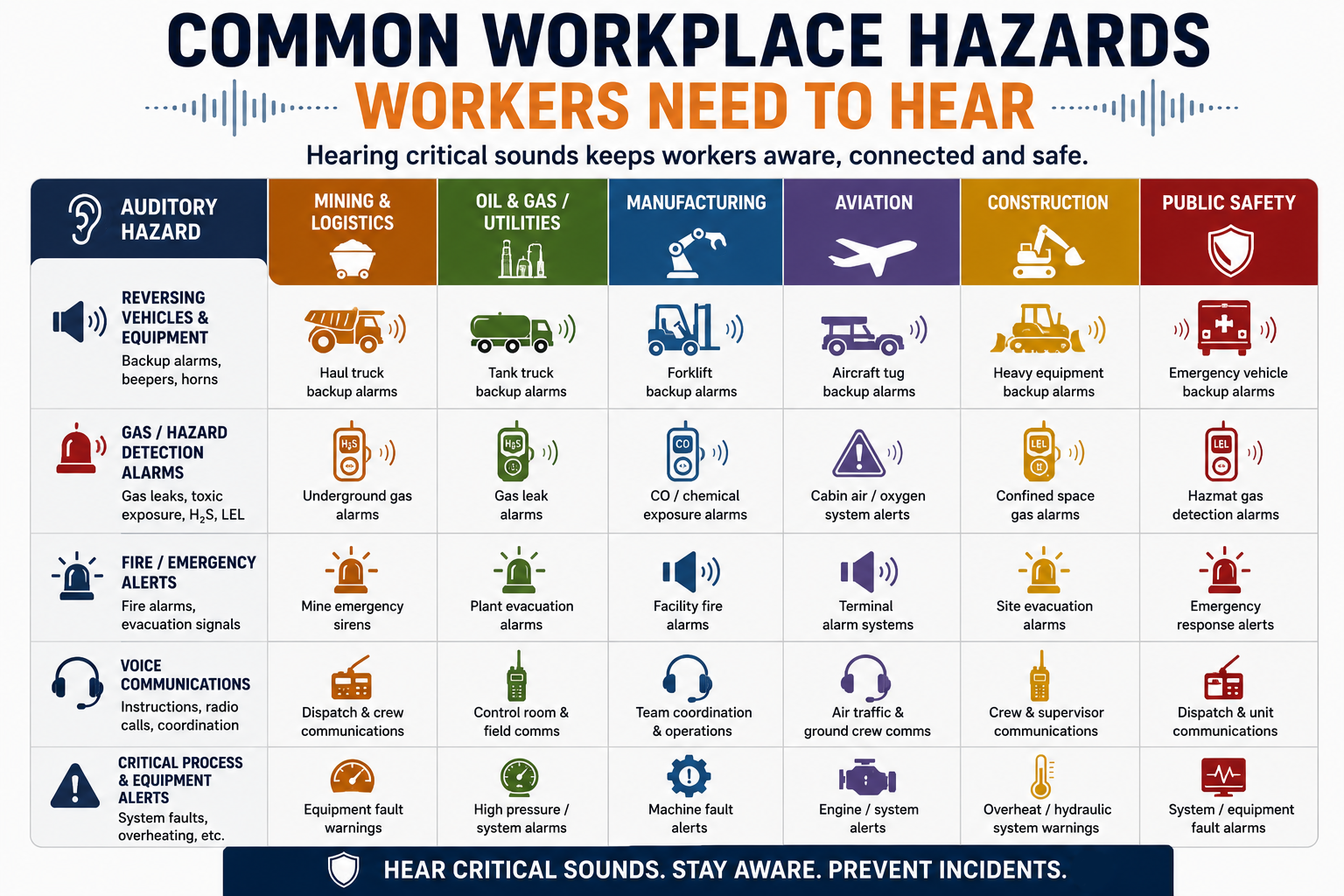
Hazard Type vs. Industry Relevance
| Auditory Hazard / Cue | Manufacturing | Mining | Oil & Gas | Utilities | Aviation | Rail | Ports & Logistics | Construction |
|---|---|---|---|---|---|---|---|---|
| Mobile equipment alarms | ✓ | ✓ | ✓ | ✓ | ✓ | ✓ | ✓ | ✓ |
| Gas/process alarms | ✓ | ✓ | ✓ | ✓ | ||||
| Evacuation/fire alarms | ✓ | ✓ | ✓ | ✓ | ✓ | ✓ | ✓ | ✓ |
| Radio/verbal commands | ✓ | ✓ | ✓ | ✓ | ✓ | ✓ | ✓ | ✓ |
| Approaching vehicle/aircraft/train | ✓ | ✓ | ✓ | ✓ | ✓ | |||
| Equipment condition sound changes | ✓ | ✓ | ✓ | ✓ | ✓ | ✓ | ✓ |
5. Industrial Communication as a Safety System
Communication isn't a convenience in high-noise environments — it's a safety control.
When workers can't communicate clearly, several risk patterns emerge:
- Instructions get repeated, shouted, or misunderstood, increasing the chance of error during high-risk tasks (lockout/tagout, crane lifts, confined space work).
- Workers remove hearing protection to hear or be heard, directly increasing noise exposure.
- Radio communication becomes unreliable in high-noise zones, delaying emergency response.
- Remote and automated operations (control rooms, AI-driven monitoring systems) generate alerts that workers on the floor may never hear if their PPE blocks both ambient sound and connected audio.
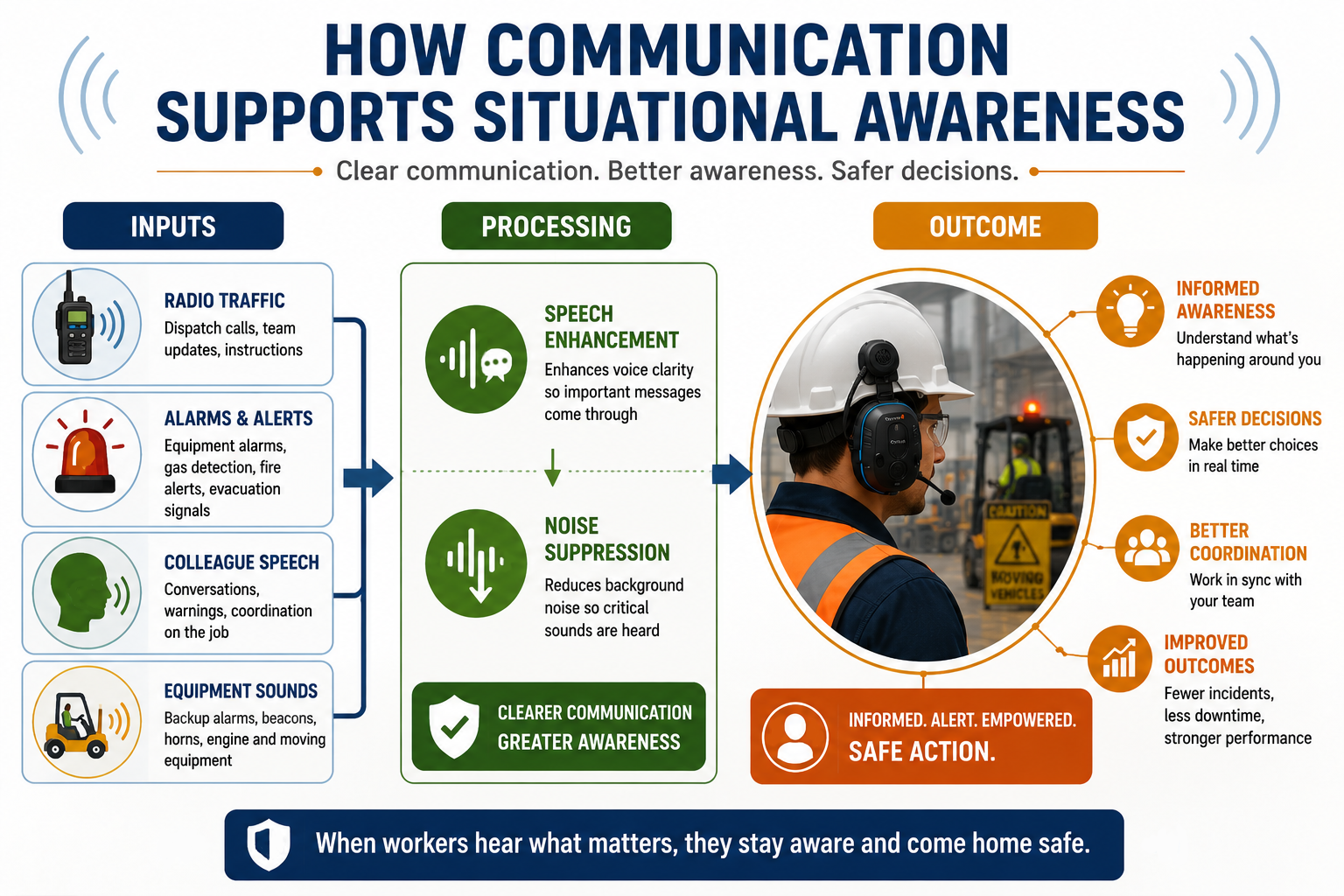
How Communication Supports Situational Awareness
Effective industrial communication systems support all three levels of situational awareness:
- Perception — clear audio delivery of radio traffic, alarms, and verbal cues despite high background noise
- Comprehension — speech clarity (not just volume) so messages are understood the first time
- Projection — real-time updates from supervisors, control rooms, or connected systems that help workers anticipate changes before they happen
6. Alarm Audibility: A Compliance and Safety Blind Spot
What Is Alarm Audibility?
Alarm audibility refers to whether an alarm signal can actually be heard and recognized by workers in their real working conditions, including while wearing hearing protection, not just whether the alarm meets a decibel specification on paper.
Many sites test alarm systems for compliance (e.g., ensuring alarms exceed ambient noise by a required margin under standards like ISO 7731 for auditory danger signals) but don't re-test audibility with hearing protection in use. This creates a compliance gap: the alarm "works" on paper, but in practice, a worker wearing standard earmuffs in a high-noise area may not perceive it at all.
Key questions every site should be able to answer:
- Can workers hear the evacuation alarm from every work area, while wearing their assigned hearing protection?
- Are alarms acoustically distinct from routine operational noise?
- Do workers know what each alarm tone means without having to think about it?
- Is there a backup (visual, haptic, or connected digital alert) for high-noise zones where audibility can't be guaranteed?
7. Modern Hearing Protection Technology: Closing the Gap
How Does Modern Hearing Protection Preserve Situational Awareness?
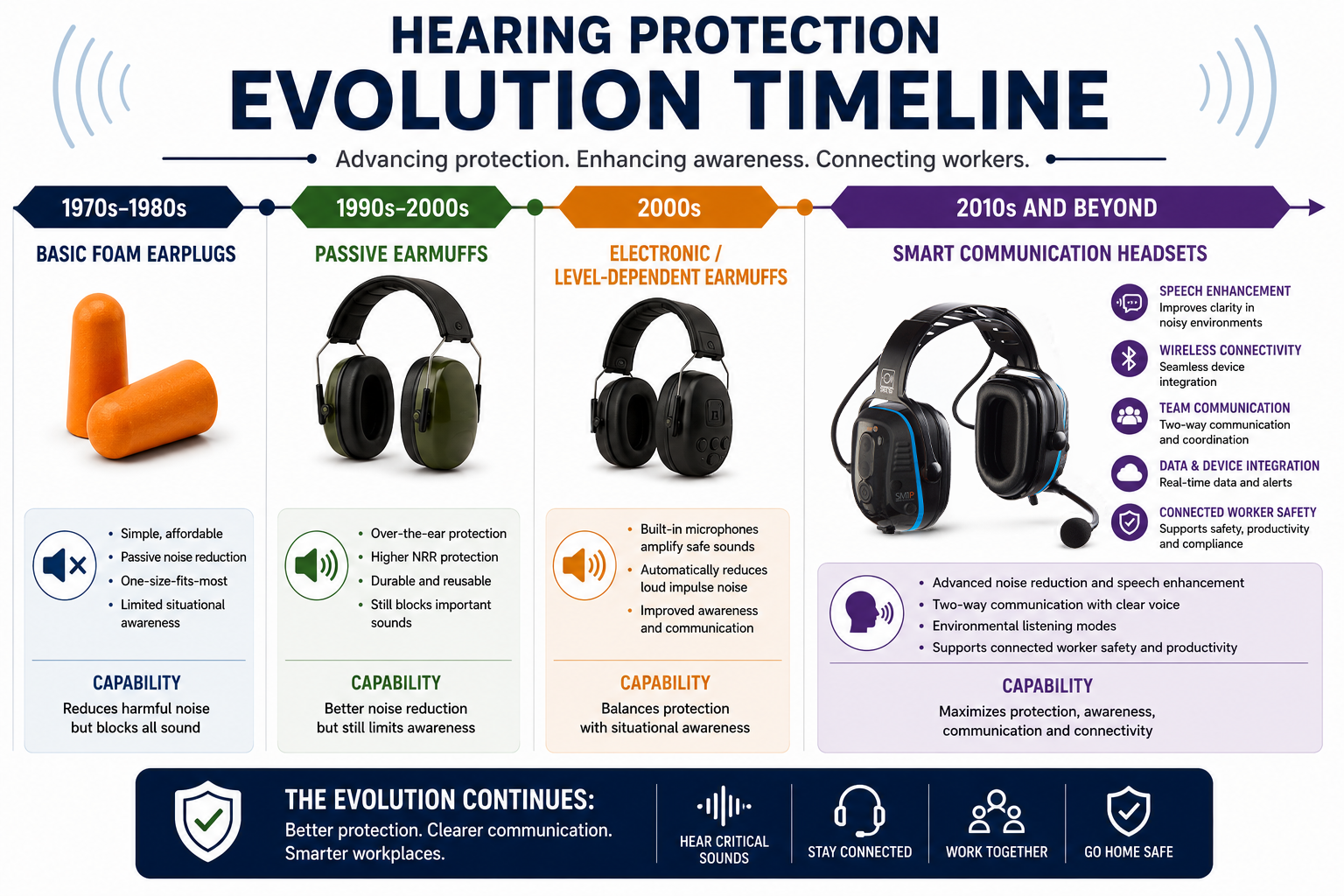
Modern hearing protection devices use electronic sound processing, including speech enhancement, noise suppression, and level-dependent amplification, to selectively reduce harmful noise while preserving or amplifying important sounds like speech, alarms, and approaching equipment.
This is fundamentally different from passive protection, which reduces all sound by a fixed amount regardless of its source or importance.
Speech Enhancement and Noise Suppression Explained
- Noise suppression identifies and reduces steady-state, non-essential background noise (machinery hum, wind, ambient industrial noise) without simply lowering overall volume.
- Speech enhancement isolates and clarifies the human voice frequency range, making spoken communication, over radio or face-to-face, intelligible even in environments above 95–100 dB.
- Level-dependent (sound-restoration) circuitry allows ambient sounds below a safe threshold to pass through close to naturally, while instantly compressing sudden loud impulses (like an air horn or impact noise) to safe levels.
Together, these technologies allow a worker to remain fully protected from harmful noise exposure while still hearing alarms, colleagues, and changes in their environment, addressing the core tension this article opened with.
What Is 360° Situational Awareness?
360° situational awareness, in the context of hearing protection, refers to a worker's ability to perceive sound from all directions, not just amplified audio from a radio or headset, but the full acoustic environment: footsteps, vehicle approach, alarms, and voices, regardless of direction.
This matters because directional hearing is part of how humans judge distance and threat. A worker who can only hear what's piped directly into their ears (and nothing else) loses spatial awareness, even if the audio they do hear is clear.
Sensear's approach, built around SENS® Technology, is one example of how speech enhancement and noise suppression can be engineered specifically to support this kind of full-environment awareness, while still meeting hearing protection attenuation requirements. The goal industry-wide should be the same regardless of vendor: protection and awareness as a single design requirement, not a trade-off.
Want to compare hearing protection options for your noise environment and communication needs?
Try the Headset Selector Tool | Learn About SENS® Technology
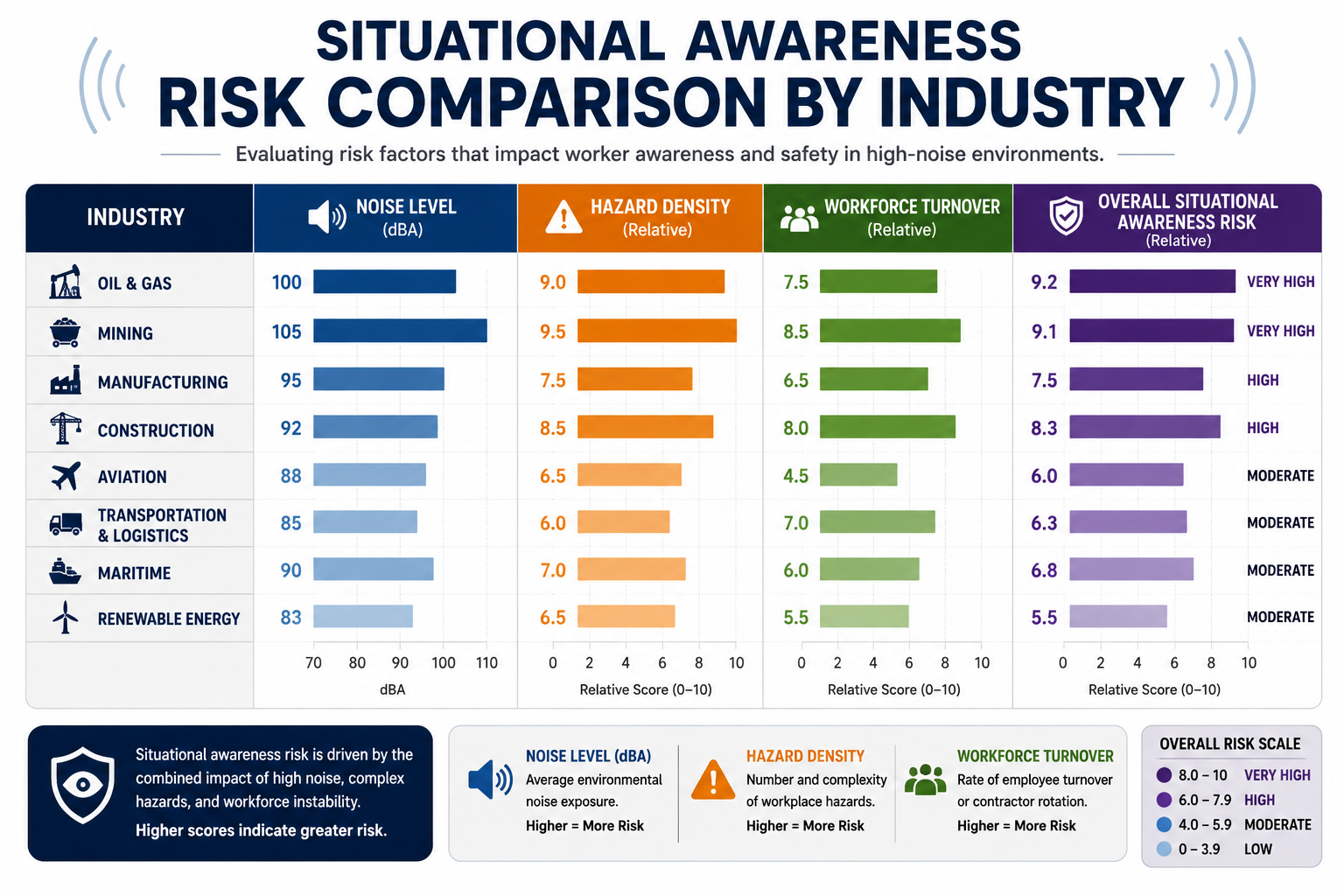
8. Situational Awareness Risk by Industry
Different industries face different combinations of noise exposure, hazard types, and operational complexity. The table below summarizes general risk patterns (use as a starting point for site-specific risk assessments):
| Industry | Typical Noise Levels | Key Awareness Risks | Why It Matters in 2026 |
|---|---|---|---|
| Manufacturing | 85–100+ dB | Machinery alarms, forklift traffic, line changeovers | Increasing automation and cobots change movement patterns workers must anticipate |
| Mining | 90–110+ dB | Heavy vehicle movement, blast warnings, ground conditions | Autonomous haul trucks and remote operations increase need for awareness near unmanned equipment |
| Oil & Gas | 85–105 dB | Gas detection alarms, process alarms, confined space communication | Aging assets + aging workforce increase reliance on clear alarm response |
| Utilities | 80–100 dB | Switching alerts, vehicle traffic, lone-worker scenarios | Workforce shortages increase lone/remote work, raising reliance on connected communication |
| Aviation | 100–140 dB (ramp) | Aircraft movement, ground equipment, marshalling signals | High-consequence environment with constant equipment movement around personnel |
| Rail | 90–110 dB | Train approach, shunting signals, track worker protection | Quiet electric/hybrid trains can be harder to hear approaching |
| Ports & Logistics | 85–100 dB | Crane operations, container handling, vehicle congestion | High equipment density and automation increase collision risk |
| Waste Management | 85–100 dB | Compactors, vehicle reversing, sorting line hazards | High turnover means more inexperienced workers in high-risk zones |
| Food Processing | 85–95 dB | Line equipment, forklift traffic, hygiene-zone communication | PPE + hairnets + hearing protection compound isolation effects |
| Data Centers | 75–95 dB | Cooling systems, alarms, restricted-access protocols | Rapid AI-driven buildout is increasing headcount in historically low-noise-awareness facilities |
| Construction | 85–105 dB | Heavy equipment, power tools, overhead hazards | Transient sites and subcontractor turnover increase awareness gaps |
9. Connected Worker Safety and the Future of Hearing Conservation
The connected worker movement (e.g., wearables, real-time monitoring, digital communication platforms, etc.) is reshaping industrial safety. Industry estimates put the global connected worker technology market in the range of roughly USD 8–9 billion in 2025, growing toward USD 20 billion by 2030, driven largely by labor shortages, aging workforces, and the need to capture institutional knowledge as experienced workers retire.
Why This Matters for Hearing Protection
Connected worker platforms increasingly route critical information (e.g., alarms, supervisor instructions, AI-generated risk alerts, lone-worker check-ins, etc.) through digital audio channels. If hearing protection isn't designed to integrate with these channels and preserve awareness of the physical environment, workers face a new version of the same old problem: they can hear the app, but not the world around them (or vice versa).
The 2026 hearing conservation program needs to account for:
- Integration between hearing protection and two-way radios, intercoms, and connected worker platforms
- Audio prioritization — ensuring critical alerts (alarms, emergency comms) are never masked by routine digital chatter
- Support for less-experienced and aging workers who may need clearer speech delivery to compensate for early hearing loss
- Compatibility with autonomous and semi-autonomous equipment that may rely on audible warnings rather than visual signals alone
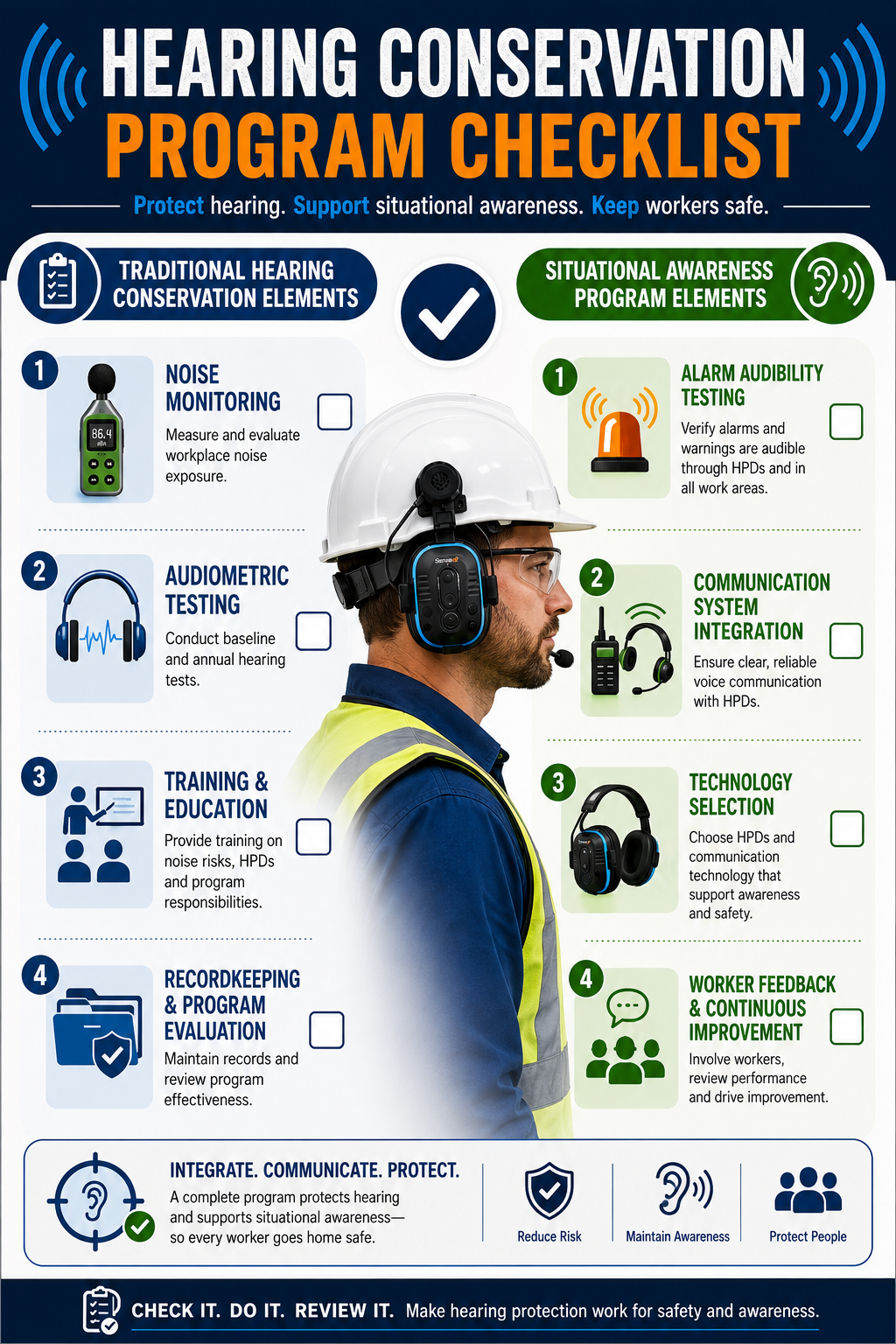
10. Building a Hearing Conservation Program That Supports Awareness (Checklist)
Use this checklist to assess whether your hearing conservation program addresses situational awareness, not just exposure reduction:
- ☐ Noise monitoring and exposure assessments are current (per OSHA/NIOSH/EU/HSE requirements as applicable)
- ☐ Hearing protection is selected based on attenuation and communication needs, not attenuation alone
- ☐ Alarm audibility has been tested with hearing protection in place, in real working conditions
- ☐ Workers can communicate verbally or via radio without removing hearing protection
- ☐ New and temporary workers receive training on site-specific alarms and auditory cues before entering high-noise areas
- ☐ Hearing protection integrates with site communication systems (radios, intercoms, connected worker platforms)
- ☐ Audiometric testing data is reviewed for trends, including early-stage hearing loss in aging workforce segments
- ☐ Backup visual or haptic alerts exist for areas where audibility can't be guaranteed
- ☐ Situational awareness is included as an evaluation criterion when procuring new hearing protection
Key Takeaways
- Situational awareness is a core safety requirement, not an optional add-on to hearing protection.
- Traditional earplugs and earmuffs reduce all sound equally, which can prevent workers from hearing alarms, warnings, and colleagues.
- Worker isolation caused by hearing protection is itself a safety risk, not just a hearing health issue.
- Global standards (OSHA, NIOSH, EU Directive 2003/10/EC, HSE, ISO) focus on exposure reduction but don't, on their own, guarantee awareness.
- Modern hearing protection technology (speech enhancement, noise suppression, and 360° awareness) allows workers to stay protected and aware at the same time.
- 2026 workplace realities (workforce shortages, aging workers, automation, connected worker platforms) make situational awareness more important, not less.
FAQ: Situational Awareness and Hearing Protection
Can you have situational awareness while wearing hearing protection?
Yes. Modern hearing protection with speech enhancement and noise suppression technology can reduce harmful noise while preserving a worker's ability to hear alarms, voices, and environmental sounds, allowing both protection and awareness.
What is situational awareness in the workplace?
Situational awareness in the workplace is the ability to perceive relevant sounds and conditions in the environment, understand what they mean, and anticipate what will happen next in order to respond safely. It involves three levels: perception, comprehension, and projection.
Does hearing protection reduce situational awareness?
Traditional passive hearing protection (foam earplugs, standard earmuffs) can reduce situational awareness because it attenuates all sound equally, including alarms and warnings, not just harmful noise. Electronic hearing protection with selective sound processing is designed to minimize this effect.
What noise level requires hearing protection at work?
In the U.S., OSHA requires a hearing conservation program when worker noise exposure reaches an 8-hour time-weighted average of 85 dBA. The EU and UK use a similar 85 dB(A) upper exposure action value under Directive 2003/10/EC and the Control of Noise at Work Regulations.
What is alarm audibility and why does it matter?
Alarm audibility is whether workers can actually hear and recognize an alarm under real working conditions, including while wearing hearing protection. An alarm can be technically compliant on paper but still inaudible to a worker wearing standard earmuffs, creating a hidden safety gap.
What is speech enhancement technology in hearing protection?
Speech enhancement is a technology used in modern hearing protection devices that isolates and clarifies the frequency range of human speech, making spoken communication clearer in high-noise environments without increasing overall noise exposure.
How does noise suppression differ from noise cancellation?
Noise suppression reduces specific unwanted background sounds (such as steady machinery hum) while preserving important sounds like speech and alarms. Noise cancellation (commonly used in consumer headphones) typically reduces overall ambient sound and is not designed for selective preservation of safety-critical sounds.
Why is worker isolation a safety risk?
Worker isolation caused by hearing protection can prevent workers from hearing colleagues, alarms, or approaching equipment, increasing the risk of collisions, miscommunication during critical tasks, and delayed response to emergencies.
How is automation changing situational awareness requirements?
Increasing use of autonomous and semi-autonomous equipment (such as automated guided vehicles and autonomous haul trucks) means workers must be able to hear and respond to equipment that may not behave or signal the way human-operated equipment does, increasing the importance of maintained situational awareness.
What should a modern hearing conservation program include?
A modern hearing conservation program should include noise monitoring, audiometric testing, properly selected hearing protection, training, recordkeeping, alarm audibility testing with PPE in use, and integration between hearing protection and site communication systems.
Conclusion
Situational awareness and hearing protection are not opposing goals, rather they're two halves of the same safety requirement. A worker who can't hear isn't fully protected, even if their hearing is. And a worker who can hear everything but is losing their hearing isn't protected either.
For 2026 and beyond, hearing conservation programs need to be evaluated not just by exposure reduction, but by whether they help workers stay connected to their environment (to alarms, to colleagues, and to the changing conditions around them). As workplaces grow more automated, more connected, and more short-staffed, that connection matters more than ever.
The technology to achieve both exists today. The next step for safety leaders is making situational awareness an explicit requirement (not an afterthought) in how hearing protection is selected, deployed, and evaluated.
Have questions about alarm audibility or hearing protection selection for your site?
Talk to a Sensear safety specialist for site-specific guidance.