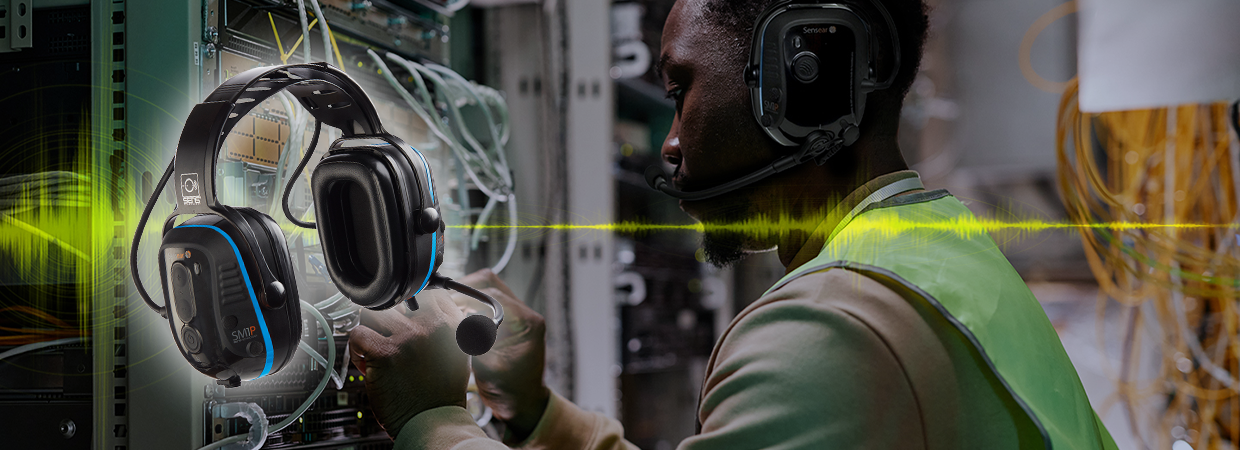
A data hall doesn't look like a hazardous noise environment. There's no stamping press, no grinder, no rock crusher. The floors are clean, the lighting is even, and the people working there are usually carrying a laptop.
The sound, though, is constant. Server fans, air handlers, chillers, pumps, UPS equipment, and standby generators run around the clock, and the people who maintain that infrastructure work inside it. Sometimes for a few minutes, sometimes for a full shift.
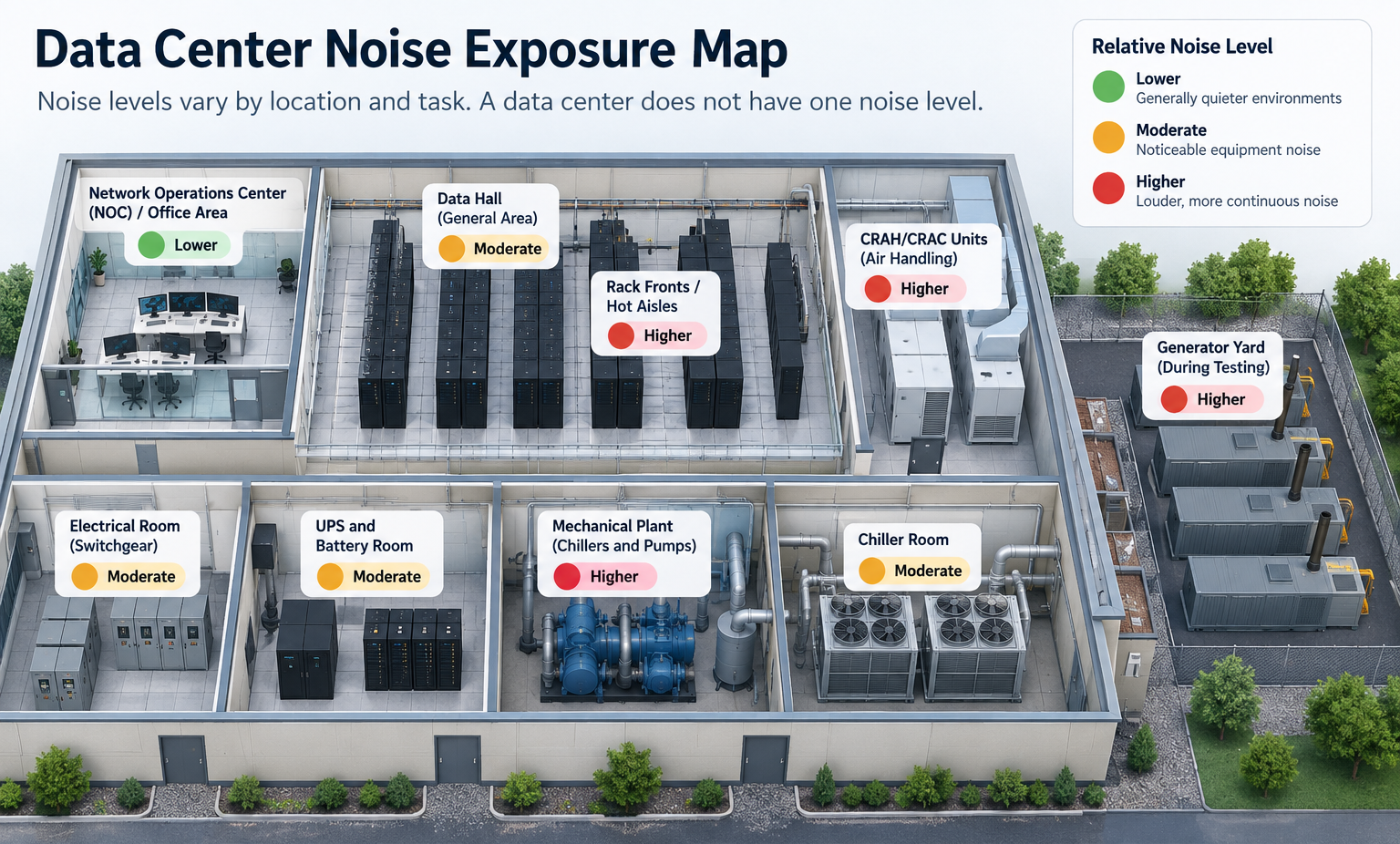
So how loud is a data center? There is no single number. Noise varies by facility, by room, by equipment, by IT load, by cooling architecture, and by where a worker is standing and for how long.
For anyone responsible for worker safety, the more useful question is what noise exposure individual workers actually experience during their tasks and across their shifts. Occupational noise risk depends on intensity and duration together. A technician who walks a cold aisle for ten minutes and a technician who spends four hours commissioning equipment beside a running CRAH unit are in the same building under very different conditions.
That's the principle behind the rest of this article: measure exposure, don't assume.
How Loud Are Data Centers?
Data center noise comes from equipment and airflow rather than from impact or process noise, which makes it steady and pervasive rather than sharp and intermittent. The level a worker actually encounters depends on site-specific factors:
- Server model, rack density, and how hard server fans are working under current IT load
- Cooling architecture, containment strategy, and airflow management
- Proximity to rack fronts, hot aisles, CRAC/CRAH units, chillers, pumps, and air handlers
- Time spent in electrical rooms, UPS and battery spaces, and mechanical plant areas
- Whether generators or load banks are running for scheduled testing
- Room geometry, ceiling height, and hard reflective surfaces
Noise also concentrates in specific zones. A network operations center or office area may be genuinely quiet while a hot aisle, a mechanical room, or a generator yard during testing runs substantially louder than the facility's "average."
Industry technical writing sometimes cites a broad range in the neighborhood of 70–80 dB(A) for conventional data center environments covering IT, electrical, mechanical, and cooling equipment (Simple Mining, 2026). Treat that as directional context only. It's vendor-authored, it predates current high-density deployments, and it is not a compliance measurement for your building.
No authoritative dataset establishes one representative noise level for all modern data centers, hyperscale campuses, or AI halls. That gap is worth acting on rather than working around. If you need to know whether your workers are approaching regulatory thresholds, the answer comes from measuring your own site during representative operations.
What's the Difference Between a Sound Level and a Worker's Noise Exposure?
This distinction is usually skipped, and it determines whether a facility is measuring anything useful.
NIOSH separates three related concepts (NIOSH, Understand Noise Exposure):
Sound level is the noise measurement at a given point in time. It tells you how loud a location is right now.
Time-weighted average (TWA) is the sound level averaged over a work shift, normally eight hours. It accounts for how loud the noise is and how long the worker is exposed at each level.
Noise dose is the percentage of a worker's allowable daily exposure that has been used. A dose of 100% or more means the daily limit has been exceeded.
Two supporting terms are worth defining. "dB(A)" stands for A-weighted decibels; the A-weighting filter approximates the frequency response of human hearing, which is why it's the standard metric for hearing-risk assessment. Personal noise dosimetry uses a small device worn by a worker that captures actual sound exposure across every task and location over a shift.
The practical difference shows up in a single data hall. A technician making three short entries totaling 20 minutes and a technician spending four hours troubleshooting a failed PDU in that same aisle accumulate very different daily doses, even though the room measurement is identical.
“A room measurement tells you how loud a location is. A dosimeter helps tell you how much noise a worker actually experiences.”
NIOSH treats these as complementary rather than alternative methods. Area measurements with a sound level meter identify which zones and which equipment are loud, which supports noise mapping and engineering decisions. Personal dosimetry, worn during representative work, helps establish the noise exposure individual employees accumulate across their tasks and locations over a shift.
What Do OSHA and NIOSH Say About Workplace Noise?
These two frameworks are frequently blurred together. They aren't interchangeable, and the difference has real compliance consequences.
OSHA sets enforceable requirements
For general industry, which covers most U.S. data center work, occupational noise is regulated under 29 CFR 1910.95.
85 dB(A) as an 8-hour TWA is the action level. At or above this level, the employer must administer a continuing, effective hearing conservation program and make hearing protectors available to affected employees at no cost. When information indicates that any employee's exposure may reach this level, the employer must develop and implement a monitoring program.
90 dB(A) as an 8-hour TWA is the permissible exposure limit (PEL). When employees are exposed above the levels in OSHA's Table G-16, feasible engineering or administrative controls must be used. Personal protective equipment is what's required if those controls fail to bring exposure within the table, not a substitute for attempting them.
Mandatory use of hearing protectors applies to employees required to wear PPE under paragraph (b)(1), and to employees exposed at or above the 85 dB(A) action level who have not yet had a baseline audiogram established or who have experienced a standard threshold shift.
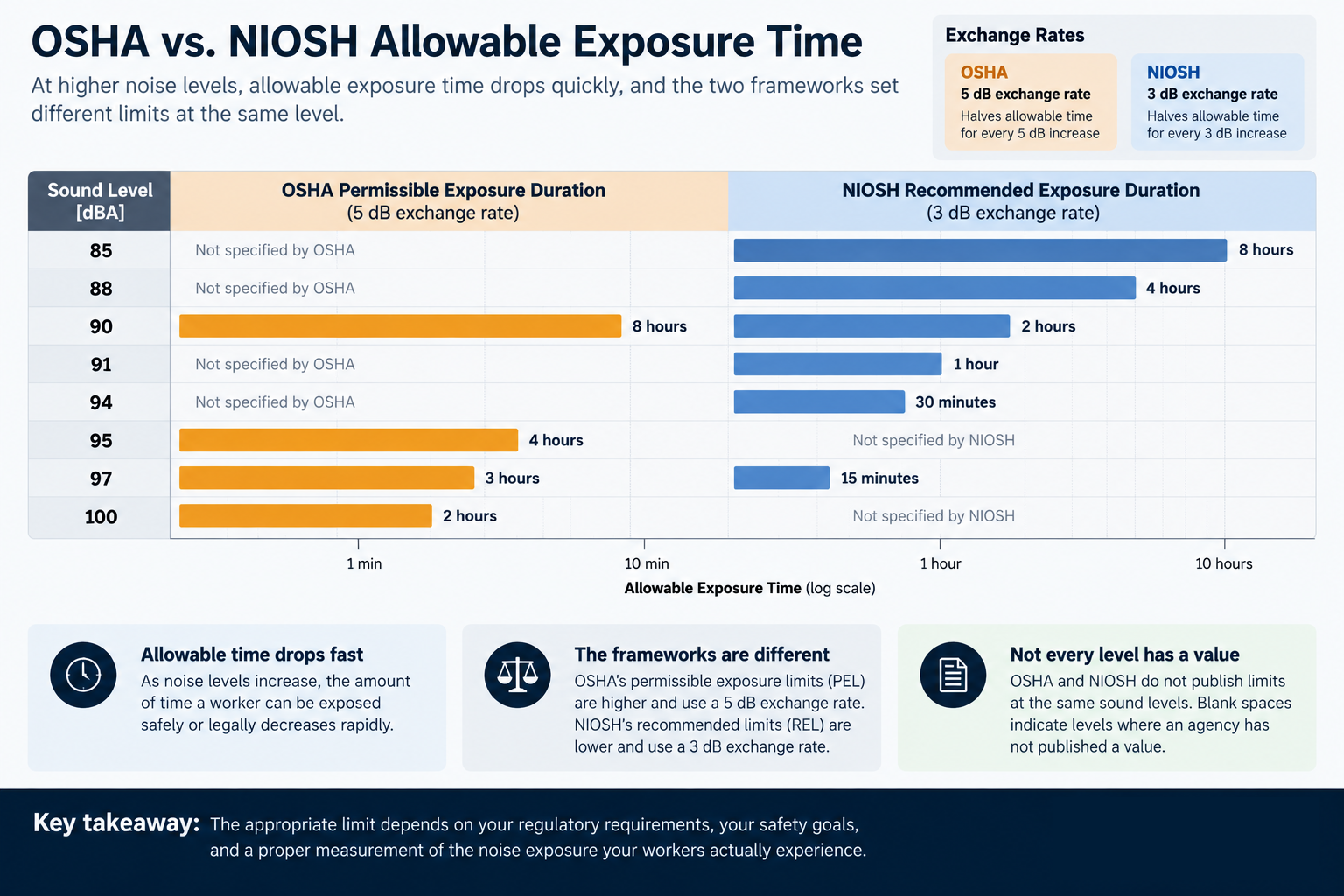
OSHA applies a 5-dB exchange rate: allowable duration halves for every 5 dB increase in sound level.
NIOSH publishes health-based recommendations
NIOSH recommendations are not legally binding, but they're more protective and are widely used as a best-practice benchmark.
The NIOSH recommended exposure limit (REL) is 85 dB(A) over an eight-hour shift, applied with a 3-dB exchange rate. For every 3 dB increase in noise level, the recommended exposure duration is cut in half.
Published exposure durations, side by side
| Sound Level | OSHA Permissible Duration | NIOSH Recommended duration |
|---|---|---|
| 85 dB(A) | Action level — hearing conservation program required | 8 hours |
| 88 dB(A) | Not listed in Table G-16 | 4 hours |
| 90 dB(A) | 8 hours (PEL) | Not listed |
| 91 dB(A) | Not listed | 2 hours |
| 95 dB(A) | 4 hours | Not listed |
| 97 dB(A) | 3 hours | 30 minutes |
| 100 dB(A) | 2 hours | 15 minutes |
OSHA establishes what an employer is legally required to do. NIOSH describes what the health evidence recommends. Meeting OSHA's requirements does not necessarily mean worker exposure is within the more protective NIOSH Recommended Exposure Limit.
Are AI Data Centers Getting Louder?
This is the question that has changed most since this article was first published in 2021, and it deserves a careful answer.
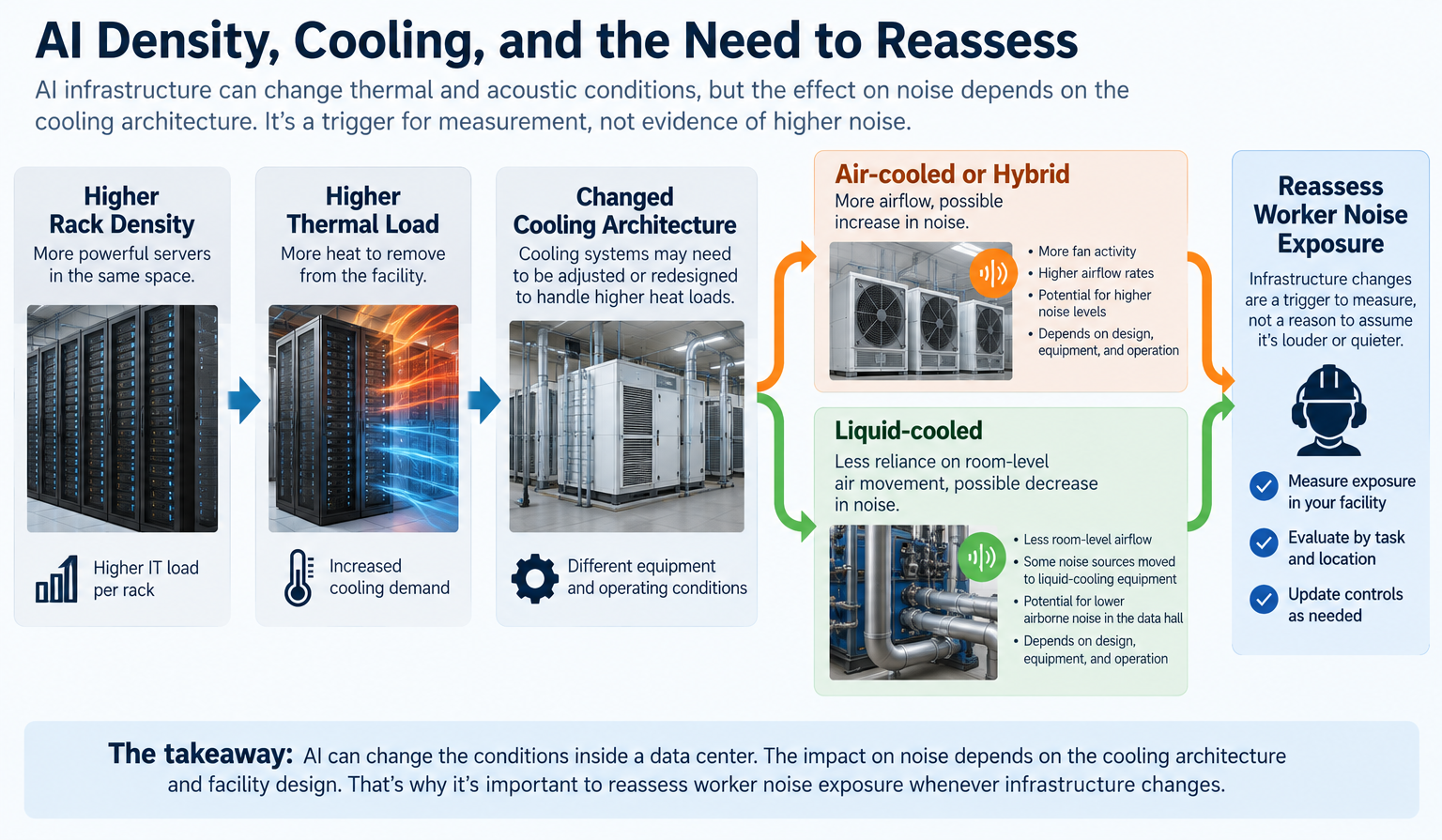
What has clearly changed is power density. ASHRAE's AI data center framework describes the shift from CPU-centric to GPU-centric infrastructure as a step change in rack-level power and thermal load. GPU clusters commonly drive densities of 40–100 kW per rack compared with 5–10 kW for legacy CPU racks, and purpose-built AI facilities routinely operate in the 50–120+ kW per rack range (ASHRAE, AI Data Center Energy Performance Framework).
More power per rack means more heat per rack, and that heat has to be moved somewhere. The acoustic consequences run in two directions.
Noise could increase. In air-cooled or hybrid halls, higher thermal load can mean faster server fan operation, more air movement, additional or larger cooling equipment, and mechanical infrastructure running closer to capacity.
Noise could decrease. ASHRAE identifies direct-to-chip liquid cooling as an inherently more efficient heat transfer method, rear-door heat exchangers as a hybrid approach that reduces room heat load, and immersion cooling as another high-density option. Designs that move heat with liquid rather than room-scale airflow can reduce dependence on high-volume air movement in the occupied space.
So AI infrastructure isn't a reason to assume data centers have gotten louder. It's a reason to check. Major changes to rack density, cooling topology, fan control strategy, IT load profile, or the way technicians work in a space all warrant reassessing noise exposure.
A facility that measured its data hall in 2021, retrofitted for high-density AI workloads, and never remeasured doesn't know what its technicians are exposed to today. That holds whether the retrofit made the space louder or quieter.
Noise Affects More Than Hearing
Hearing damage is the outcome most people associate with occupational noise, and it's permanent. OSHA states that exposure to loud noise can damage and kill hearing receptor cells in the inner ear, producing hearing loss that cannot be corrected surgically or with medication (OSHA, Occupational Noise Exposure).
Hearing loss isn't the only way noise affects a data center operation. OSHA identifies stress, reduced productivity, interference with communication and concentration, and difficulty hearing warning signals among the effects of excessive workplace noise (OSHA, Health Effects).
Speech becomes hard to understand before noise becomes hazardous
A peer-reviewed occupational noise review reports that speech generally needs to be roughly 6–12 dB louder than the background noise to be clearly understood (Themann & Masterson, Journal of the Acoustical Society of America, 2019).
That explains a good deal of what data center teams experience in steady fan noise. People raise their voices, move closer, repeat themselves, or step out of the room to be understood.
NIOSH offers a related field cue: noise levels are likely hazardous if a person has to raise their voice to speak with someone at arm's length. It's a screening indicator rather than a measurement, but it's a reasonable prompt to schedule a real assessment.
Awareness and alarms
NIOSH states that noise can reduce workers' awareness of what is happening around them, including signals, alarms, and verbal warnings (NIOSH, Prevent Noise-Induced Hearing Loss). Sensear's own work on situational awareness and hearing protection covers how that plays out on the floor.
In a data center, the sounds a worker may need to detect include a colleague calling out during electrical work, an audible alarm or fault tone, a change in equipment sound that signals a problem, instructions relayed by radio, and a vendor's remote technical support during work at the rack.
The tasks where this matters most
Communication demands tend to peak during exactly the work that puts people in the noisiest places: fault isolation and troubleshooting, rack and cabling installation, commissioning, planned maintenance, generator and load bank testing, and any procedure coordinated between people at different points in the facility.
Raising your voice isn't a control. Walking to a quiet room to take a call interrupts the work. Removing hearing protection to hear a colleague defeats the protection while the worker is still standing in the noise.
How Should Data Centers Assess Worker Noise Exposure?
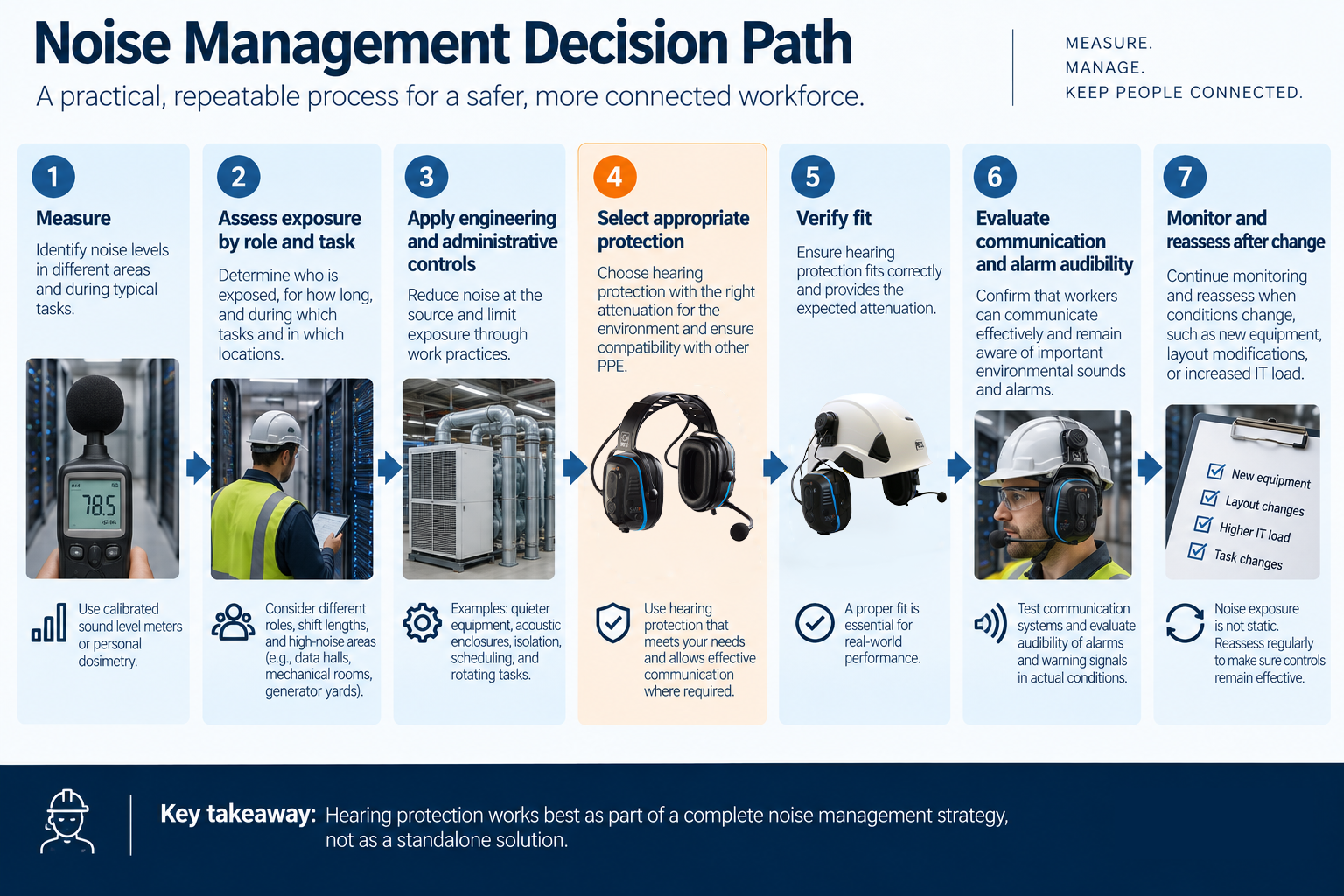
A defensible assessment follows a sequence rather than a single spot check.
- Identify potentially noisy areas. Walk the facility and list every space where equipment noise is significant, not just the data halls.
- Measure representative sound levels using a sound level meter with settings appropriate to the framework being assessed.
- Map high-noise locations and equipment. A noise map turns scattered readings into something you can plan around and identifies engineering-control candidates.
- Use personal dosimetry where appropriate. Have workers wear dosimeters during representative shifts to capture actual daily dose across tasks and locations.
- Evaluate by job role and task, not just by room. A cabling contractor, a critical facilities technician, and a mechanical technician can have very different exposure profiles in the same building.
- Assess normal and peak operating conditions, including generator testing, peak IT load, summer cooling demand, and maintenance activities.
- Reassess after significant change. New rack deployments, cooling retrofits, fan control changes, capacity expansions, and changes in work practices can all alter exposure.
Areas and equipment worth including in a noise survey
- Data halls, at rack fronts and within hot aisles
- CRAC and CRAH units and air handlers
- UPS rooms, battery spaces, electrical rooms, and switchgear areas
- Mechanical plant rooms, pumps, and chillers
- Cooling towers and outdoor mechanical yards
- Generator areas, especially during scheduled testing
- Loading docks, staging areas, and adjacent support spaces where staff spend part of the shift
Managing Data Center Noise Exposure
NIOSH recommends working through the hierarchy of controls rather than relying on PPE alone. Hearing protection sits at the bottom of that hierarchy, not at the top.
Elimination and substitution. Specify quieter equipment during procurement. Acoustic performance is a legitimate selection criterion for cooling equipment, air handlers, and enclosures, and it's far cheaper to address at purchase than to retrofit.
Engineering controls. Isolate or enclose noise sources, apply acoustic treatment in mechanical spaces, optimize airflow and containment so cooling equipment isn't working harder than necessary, keep equipment maintained, and increase the distance between routine work positions and dominant sources where the layout allows.
Administrative controls. Limit time spent in high-noise areas, schedule the loudest activities when fewer people are present, rotate tasks to distribute exposure, restrict access to spaces that don't need to be occupied, and provide quiet areas for calls, documentation, and remote support work.
Hearing protection. Select based on measured exposure, verify fit, and confirm the protector works with the rest of the job.
Why the highest NRR isn't automatically the best choice
The Noise Reduction Rating (NRR) printed on a protector often does not reflect the protection an individual worker actually achieves in real use, because real-world attenuation depends on fit. Fit testing produces a Personal Attenuation Rating (PAR), an individual estimate of how much reduction that worker achieves with that protector.
NIOSH also warns about overprotection. Too much sound reduction can make workers less aware of their surroundings, and workers may remove their protectors in order to hear properly. The recommended target is enough attenuation to bring protected exposure into the 75–85 dB(A) range (NIOSH, Provide Hearing Protection).
Compatibility matters too. NIOSH notes that earmuffs and canal caps can interfere with the fit of hard hats, helmets, respirators, and eye protection, which is relevant in data centers where electrical work may require additional PPE. Sensear's guide to selecting hearing protection by noise level walks through how attenuation requirements change as measured exposure rises.
Hearing Protection Shouldn't Prevent Communication
Once measured exposure indicates that hearing protection is warranted, a second operational question follows: how do workers stay protected while still communicating and staying aware of what's happening around them?
Conventional passive hearing protection attenuates speech along with hazardous noise. That becomes a problem when the same worker also needs to talk with a colleague at a rack, use a two-way radio during a coordinated procedure, take a call from a vendor or remote technical support, or stay aware of alarms and verbal warnings.
What happens next is predictable. The worker lifts a muff, pulls out a plug, or leaves the area. Removing protection while remaining in hazardous noise eliminates the protection at exactly the moment it's needed.
NIOSH identifies level-dependent and sound-restoration hearing protectors as useful for some intermittent exposures, since they allow lower-level sounds such as speech through while limiting hazardous levels.
More broadly, communication-capable hearing protection is worth evaluating wherever workers need both protection and reliable communication in the same space. Selection criteria expand accordingly: appropriate attenuation, speech intelligibility, awareness requirements, integration with the communication systems already in use, comfort across a full shift, and compatibility with other PPE.
How Sensear Supports Communication in Noisy Data Centers
Sensear designs hearing protection for environments where workers need to communicate without removing their PPE.
SENS® Technology is Sensear's Speech Enhancement and Noise Suppression technology, which makes face-to-face conversation possible at the rack. SENS® enhances speech while suppressing harmful background noise and supports 360º situational awareness, helping workers remain aware of surrounding sounds while their hearing protection stays in place.
Depending on the model, Sensear headsets and earplugs also support:
- Bluetooth® connectivity
- Two-way radio communication
- Short-Range headset-to-headset communication
- Dual protection configurations for higher-noise environments
The operational result is that Sensear solutions eliminate the need to remove hearing protection to communicate. A technician can troubleshoot at the rack, stay on a call with a vendor, and remain aware of surrounding sounds without lifting an earcup.
Two limits are worth stating plainly. No headset makes a facility compliant, and PPE does not replace the engineering and administrative controls OSHA requires when exposures exceed permissible levels. Communication-capable hearing protection addresses one specific problem, the trade-off workers currently make between protection and communication, inside a broader noise management program.
Capabilities differ across the range, so selection should follow from measured exposure, the communication systems already in use, other required PPE, and any applicable certification requirements.
Explore Sensear's communication solutions for data centers →
Frequently Asked Questions
How loud are data centers?
There's no single answer. Data center noise varies by facility, room, equipment, cooling architecture, IT load, and worker location. Some industry technical writing cites a broad 70–80 dB(A) range for conventional environments, but equipment-adjacent zones, mechanical rooms, and generator areas can run considerably louder. The only reliable way to know is to measure your own facility during representative operations.
At what noise level does OSHA require a hearing conservation program?
At an 8-hour time-weighted average of 85 dB(A). Under 29 CFR 1910.95, when employee noise exposures equal or exceed that level, the employer must administer a continuing, effective hearing conservation program and make hearing protectors available at no cost. When information indicates exposures may reach that level, a monitoring program is required.
What's the difference between OSHA's 85 dB(A) and 90 dB(A) thresholds?
85 dB(A) as an 8-hour TWA is OSHA's action level, which triggers hearing conservation program requirements. 90 dB(A) as an 8-hour TWA is OSHA's permissible exposure limit, above which feasible engineering or administrative controls are required. Both are OSHA requirements, and they trigger different obligations. NIOSH separately recommends a limit of 85 dB(A) over eight hours using a more protective 3-dB exchange rate.
Are AI data centers louder than traditional data centers?
Not necessarily. AI and GPU infrastructure substantially increases rack power density, which ASHRAE puts at 40–100 kW per rack for GPU clusters versus 5–10 kW for legacy CPU racks. That raises thermal load and changes cooling requirements, but whether noise goes up depends on the cooling architecture. More air movement can increase noise, while direct-to-chip liquid cooling, rear-door heat exchangers, and immersion cooling can reduce reliance on room-level airflow. Infrastructure change is a reason to reassess exposure, not a basis for assuming it rose.
How should data centers measure worker noise exposure?
Combine two methods. Use a sound level meter to measure and map area noise levels, which identifies loud zones and equipment. Use personal dosimeters worn during representative shifts to determine actual daily noise dose by role and task. Area measurements tell you how loud a location is; dosimetry tells you what a worker is exposed to.
Can hearing protection make communication more difficult?
It can. The effect depends on the noise environment, the worker's hearing, and the type and fit of the protector. Passive protection attenuates speech along with hazardous noise, and NIOSH warns that too much sound reduction can make workers less aware of their surroundings and can lead them to remove their protectors, which eliminates protection entirely. NIOSH recommends aiming for enough attenuation to bring exposure into the 75–85 dB(A) range, and notes that level-dependent or sound-restoration protectors can help with intermittent exposures.
What type of hearing protection is appropriate for data center workers?
That depends on measured exposure, task, and communication requirements rather than on the industry label. Select attenuation based on actual exposure rather than choosing the highest available NRR, verify fit individually where possible, confirm compatibility with other required PPE, and check that workers can still hear alarms, verbal warnings, and the communication systems the job depends on.
What to Take Away
Data center noise can't be characterized with an assumption or a dB(A) figure borrowed from another facility. It varies by building, room, equipment, load, and task, and what matters for worker health is the exposure an individual accumulates over a shift.
Measure. Map area levels, then use personal dosimetry to establish real exposure by role. Reassess after rack density, cooling architecture, or work patterns change.
Control. Work through the hierarchy of controls. Quieter equipment, isolation, acoustic treatment, airflow optimization, scheduling, and access limits all come before PPE.
Select protection that fits the work. Attenuation is one criterion among several. If the job requires speech, radios, remote support, or awareness of surrounding sounds, hearing protection has to accommodate that, or workers will take it off.
That last point is where hearing conservation programs most often run into friction on the floor, and it's the problem communication-capable hearing protection is built to solve.
Comparing options across your facility?
See the full range of industrial communication headsets and how they match different noise levels and communication requirements.
See our Smart Headsets → Explore Data Center Communication Solutions →This article is educational and is not legal, regulatory, or occupational health advice. Compliance obligations depend on your specific facility, measured exposures, and jurisdiction.